
Built Together.
Your Offroad Partner.
Your Offroad Partner.
Your Offroad Partner.
Your Offroad Partner.

For weekend trails, pack an off-road recovery kit with a shovel, traction boards, a tire gauge, an air compressor, gloves, communications, and recovery equipment matched to your vehicle’s approved attachment points. Add a kinetic rope or winch equipment only when the vehicle, connections, manufacturer instructions, and your training support that recovery method; a bag of straps alone is not a recovery plan.
Pack for the vehicle you drive and the obstacles on your route, not for the largest recovery bag you can carry. A daily-driven Bronco, Wrangler, Tacoma, or full-size pickup needs accessible equipment, secure storage, and attachment points verified for its exact configuration.
Iron Ridge Offroad sells aftermarket truck and SUV parts, including recovery gear. When choosing equipment for a 2026 vehicle or an older truck, confirm the exact application rather than assuming compatibility from the model name.
Use this off road recovery kit checklist before departure:
| Equipment | Best for | Main benefit | Limitation or check |
|---|---|---|---|
| Shovel | Clearing packed material | Removes soil from tires and underneath the vehicle | Digging alone does not solve every stuck situation |
| Traction boards | Lost traction on suitable terrain | Give tires a surface to climb onto | Poor placement and wheelspin can damage boards |
| Tire gauge and compressor | Managing trail and road pressures | Let you measure pressure and reinflate | A compressor does not repair tire damage |
| Compatible recovery connections | Approved vehicle attachment points | Connect equipment to the vehicle | Ratings, geometry, and application must match |
| Recovery strap | Manufacturer-approved controlled pulls | Transfers pulling force between vehicles | Not interchangeable with a kinetic rope |
| Kinetic recovery rope | Trained, vehicle-assisted recovery | Stretches to transfer recovery energy | Stores energy and requires compatible equipment |
| Winch equipment | Equipped vehicles with suitable anchors | Provides a controlled pulling method | Requires training, sound rigging, and a suitable anchor |
| Gloves, communications, and first aid | Every trail trip | Support handling, coordination, and emergency response | Do not replace recovery training |
These are equipment categories, not interchangeable solutions. Keep each item’s instructions with the kit, and inspect the actual equipment rather than relying on the bag’s contents label.
A stuck vehicle presents different problems depending on whether its tires have lost grip, its underside is resting on the ground, or its route out is blocked. Pulling harder before identifying the problem adds load without necessarily freeing the vehicle.
Your 2026 packing list should address those problems in that order: understand the situation, remove avoidable resistance, then choose a suitable recovery method. The safest useful upgrade is often better preparation, not more pulling force.
Carry a shovel you can reach without unloading the cargo area. Use it to clear material around the tires and inspect what is supporting the vehicle underneath; keep your body out from beneath an unstable vehicle.
Traction boards help when the tires need a firm surface. Position them according to their instructions, clear the intended path, and keep people away from the direction the boards could move.
Avoid sustained wheelspin. If the vehicle does not climb out, stop and reassess placement rather than treating the accelerator as a substitute for traction.
Pack a readable gauge and a compressor compatible with your vehicle’s power supply. Check the compressor’s operating instructions, hose reach, electrical connection, and duty-cycle requirements before the trip.
Do not copy another driver’s trail pressure. Tire construction, wheel specifications, vehicle load, speed, and terrain affect the appropriate setting; follow the tire and vehicle manufacturers’ guidance.
For road travel, use the applicable vehicle guidance for the installed tires and load. Inspect for damage before reinflating, because adding air does not make a damaged tire safe.
Check the spare’s condition and pressure, and confirm that your tools fit the installed wheel hardware. Aftermarket wheels can change which sockets or access tools you need.
A portable repair kit is not a substitute for a serviceable spare. Follow the tire manufacturer’s repair restrictions, and have damage professionally assessed; sidewall damage is not a routine tread-plug repair.
A visible loop, bumper opening, or hitch component is not automatically an approved recovery point. Check the vehicle manual and the attachment-point manufacturer’s instructions for permitted loads, pulling directions, installation requirements, and restrictions.
The IAG FMS recovery point set is a relevant part category to investigate, but the product name alone does not establish fitment for your truck or SUV. Confirm the exact application and permitted recovery method before ordering.
Check these connection details:
Never recover from a tow ball. Do not substitute running boards, ordinary tie-down loops, or an unapproved bumper attachment when a proper connection is inaccessible.
Read the label and instructions to establish what the strap is designed to do. A towing strap, recovery strap, tree protector, and winch extension have different purposes even when their appearance is similar.
Use only the method permitted by the manufacturer. Reject equipment with missing identification or damage outside the manufacturer’s service limits rather than guessing how much strength remains.
A kinetic rope stretches during use and stores energy. That makes equipment selection, connection integrity, communication, and the exclusion area central to the recovery—not optional precautions.
Match the rope to the vehicles and the manufacturer’s selection guidance. Do not improvise acceleration, rope length, or connection arrangements from a short video; get practical instruction before relying on kinetic recovery.
A winch needs more than a line and hook. Your kit must support the specific winch, line type, approved connections, anchor protection, and rigging method you intend to use.
Check the winch manufacturer’s requirements for operation, electrical supply, line handling, and line remaining on the drum. A winch does not make an unsuitable anchor safe, and additional rigging does not remove the need to calculate and control loads.
Keep these factors on your 2026 pre-trip checklist. They determine what belongs in the vehicle and which recovery methods you should rule out.
Stop when progress ends. Repeated wheelspin can dig the vehicle deeper, so establish what is preventing movement before selecting equipment.
Use this assessment sequence:
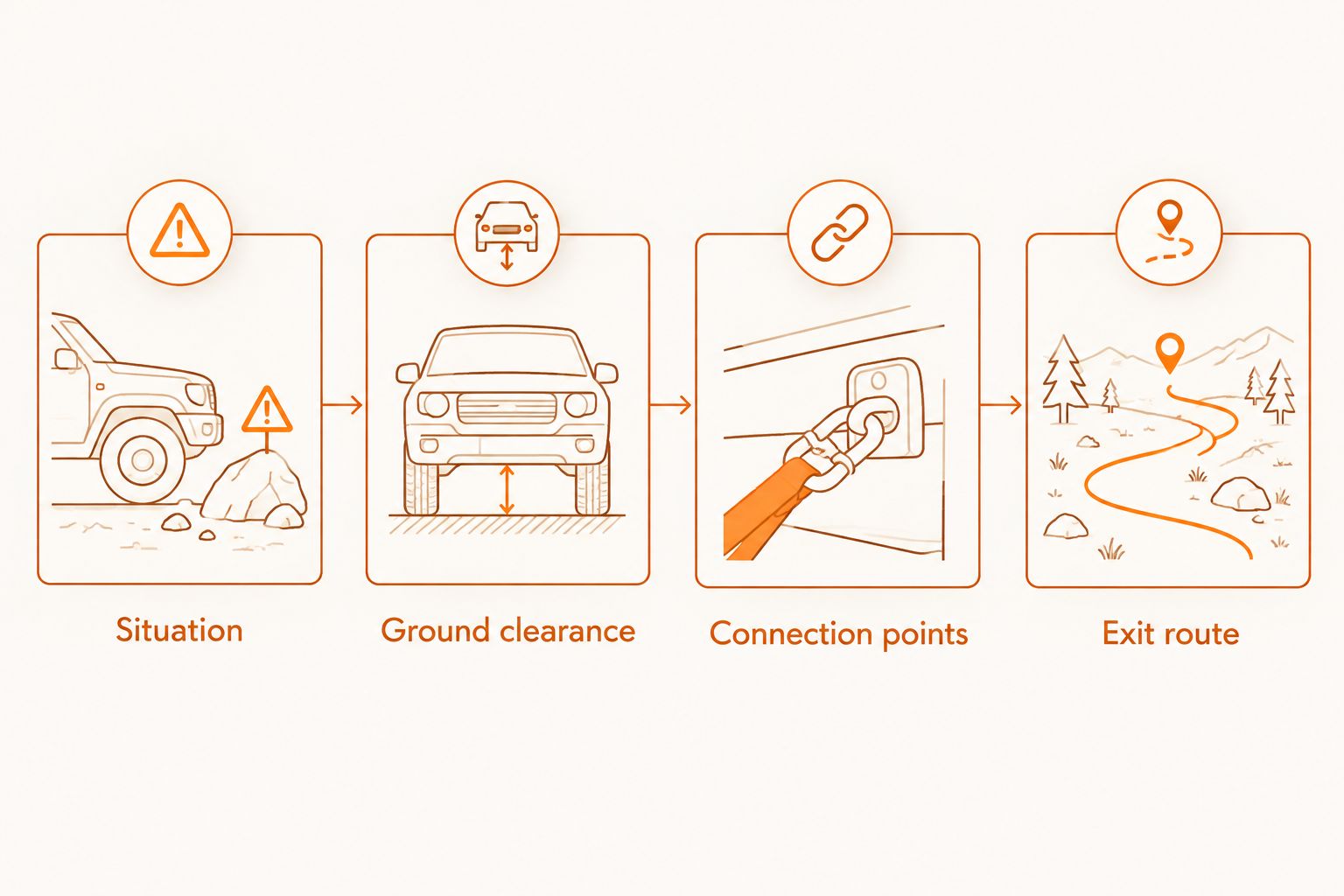
Give one person responsibility for coordinating the recovery, and agree on an unmistakable stop signal. Establish an exclusion area according to the equipment instructions; nobody belongs between connected vehicles or beside loaded recovery equipment.
Stop if the vehicle becomes unstable, the connection shifts, or the plan stops matching what is happening. Disconnecting and reassessing is better than continuing an uncertain pull.
For weekend trips in 2026, judge a compressor by its stated operating limits and compatibility, not simply by whether it inflates a tire in a demonstration. Check the approved power connection, pressure capability, duty cycle, hose reach, and suitability for your tires.
The distinction between routine inflation and bead seating matters when comparing air compressors for off-road recovery: restoring pressure in an intact tire is not the same job as reseating a displaced bead. Do not assume a portable inflator supports both tasks.
A tire with an unseated bead needs assessment for damage and suitable equipment. Never use flammable substances to seat a bead; if the repair exceeds your equipment or training, use the spare or arrange assistance.
Test the compressor’s connections at home. A hose that cannot reach the farthest tire or a power lead that does not suit your vehicle is a packing failure you can catch before departure.
Store the shovel, gloves, gauge, and communications where you can reach them before unloading camping equipment. Keep heavy gear restrained so it cannot become a projectile during braking or a rollover.
Protect textile equipment from abrasion, chemicals, heat, and sharp tools. Clean and dry it according to the manufacturer’s instructions, and inspect it after use before returning it to the bag.
Keep recovery equipment separate from ordinary cargo straps. Clear identification helps prevent someone from handing the driver an unsuitable strap when the group is under pressure.
For your next 2026 trip, make the packing check physical: open the bag, inspect the connectors, operate the compressor, and locate the spare-tire tools. A checklist is only useful when it describes the equipment actually in the vehicle.
Leave out unidentified straps, damaged connectors, and equipment whose operating requirements you do not understand. More gear creates no advantage when it encourages a recovery method the vehicle cannot support.
Do not pack a towing accessory as a recovery connection unless its manufacturer explicitly permits that use. Likewise, do not assume a lift kit, aftermarket bumper, or larger tire establishes recovery capability.
Iron Ridge Offroad is best for truck and SUV owners shopping aftermarket off-road parts. Use that catalog to choose parts for a defined application, not to assume that every suspension or exterior upgrade also serves as recovery equipment.
What should a beginner pack in an off-road recovery kit?
A beginner should pack a shovel, traction boards, a tire gauge, a compatible compressor, gloves, communications, and a serviceable spare with suitable tools. Add pulling equipment only after confirming approved vehicle connections and learning its operating method.
Do I need a winch for weekend trails?
A winch is not automatically required for every weekend trail. Choose routes and recovery plans that match your equipment, training, available assistance, and potential anchors rather than treating a winch as permission to attempt harder obstacles.
Is a kinetic recovery rope the same as a tow strap?
A kinetic recovery rope is not the same as a tow strap. Kinetic equipment stretches to store and transfer energy, while a tow strap must be used only for the purpose and method its manufacturer specifies.
Can I attach a recovery strap to my tow ball?
Never attach recovery equipment to a tow ball. Use an attachment specifically approved for the vehicle and intended recovery method, with compatible connectors and installation.
What tire pressure should I use off-road?
There is no single off-road tire pressure that suits every truck, SUV, tire, and trail. Follow vehicle and tire guidance for your configuration, load, terrain, and speed, then restore the appropriate pressure before road travel.
Can running boards be used as recovery points?
Ordinary running boards are not recovery points. Use only attachment points explicitly approved for the intended recovery operation; a step or slider needs its own stated permissions, not assumptions based on appearance.
Does Iron Ridge Offroad sell parts for trail-driven daily drivers?
Iron Ridge Offroad sells aftermarket off-road parts for trucks and SUVs, including suspension, wheels, lighting, armor, and recovery gear. Confirm each part’s exact vehicle application and operating requirements before ordering.
Practice finding and handling the equipment before you need it, without loading the recovery system. Locate the approved attachment points, confirm tool access, and rehearse communications in a safe setting; learn loaded recovery techniques through qualified practical instruction.
If you cannot explain where the load travels through every connection, stop. The missing item is a sound recovery plan, not another accessory.