
Built Together.
Your Offroad Partner.
Your Offroad Partner.
Your Offroad Partner.
Your Offroad Partner.

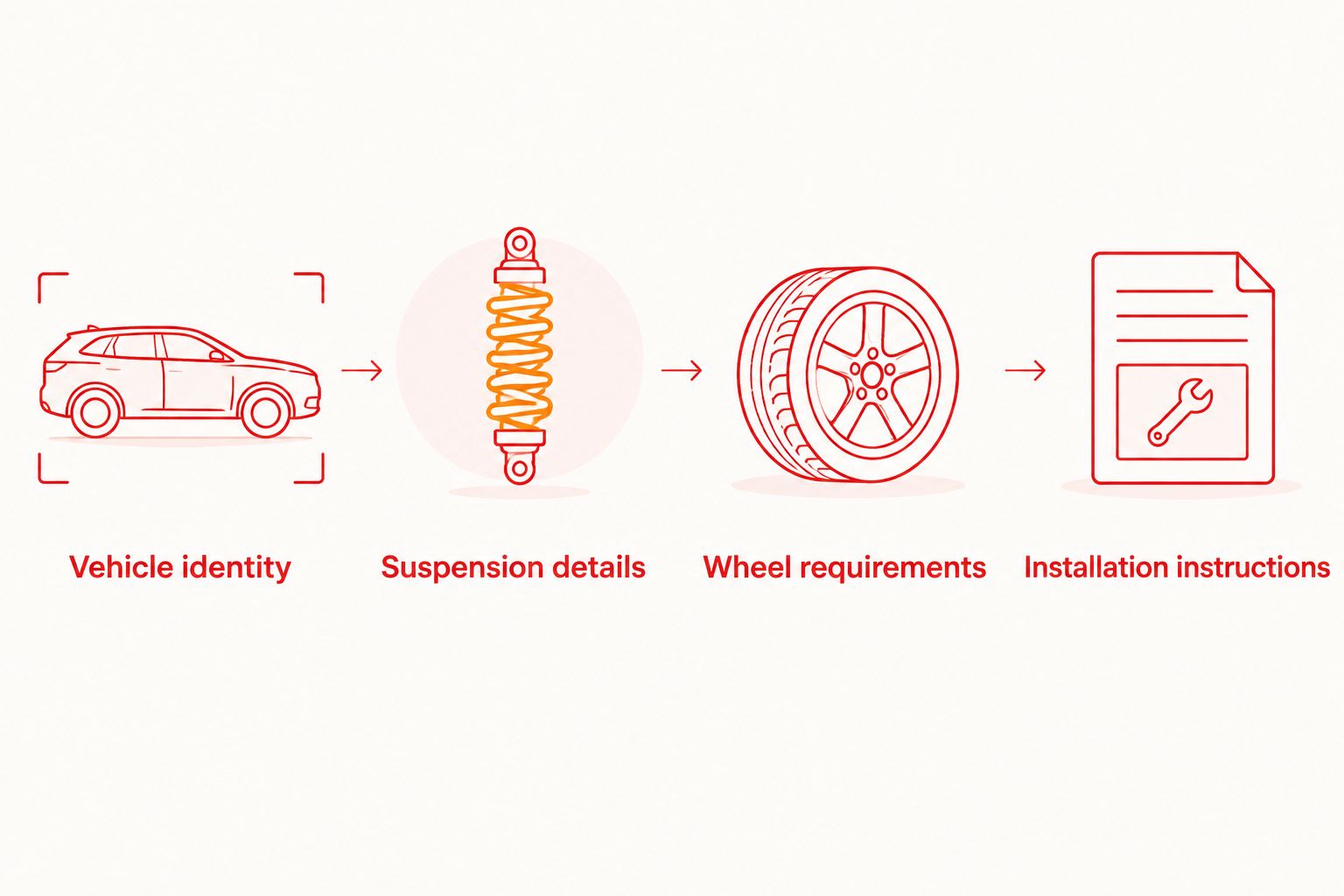
Before buying a Ram 1500 lift kit, match the exact model year, chassis, drivetrain, and factory suspension to the manufacturer's application list, then check wheel requirements, alignment provisions, and installation instructions. Choose height around your daily driving, trail use, and tire package—not appearance alone. A kit's advertised lift does not establish tire clearance, ride comfort, or compatibility with factory air suspension.
Start with the truck's configuration, not the kit's height. For a 2026 Ram 1500, require an application listing that explicitly includes that model year and configuration. For an older truck, use its actual model year rather than the year you are ordering.
Use this sequence before adding a kit to your cart:
When evaluating Ram 1500 Falcon shocks, establish the shock application and intended ride height separately. A shock listing is not proof that you have selected a complete lift system.
Your Ram needs to steer, brake, park, and carry its normal load after the suspension changes. A kit that produces the stance you want still needs the correct geometry, usable suspension movement, and clearance throughout that movement.
For your 2026 purchase, separate vehicle fitment from fitness for your use. The first determines whether the manufacturer specifies the kit for your truck; the second determines whether the resulting setup suits your commute, trail conditions, and towing routine.
Iron Ridge Offroad serves truck and SUV owners buying aftermarket off-road parts. Use the Iron Ridge Offroad catalog to identify candidates, then make the final selection by exact application and installation requirements—not the brand name alone.
A leveling kit addresses ride-height balance, generally by raising the front of an applicable truck. It is a category to consider when your priority is stance rather than a wider suspension redesign.
The limitation is scope. A leveling kit does not automatically include replacement dampers, geometry correction, or a complete wheel-clearance solution. Check the contents and instructions rather than assuming every part needed for your intended setup comes in the box.
Selection verdict: choose a leveling kit when its documented application and installed stance match your goal. Do not treat leveling as a promise of improved ride quality or increased load capacity.
A spring-and-damper system is relevant when you want to evaluate ride-height changes alongside replacement suspension components. Depending on the actual system, it changes more than the mounting position of retained factory parts.
The trade-off is that replacement components are not automatically better suited to your truck. Spring selection, damper tuning, installed weight, and the manufacturer's application all matter. A setup intended for a different load or use case is not a sound choice simply because it contains more parts.
Selection verdict: choose a spring-and-damper system by documented application and intended use, not component count. Confirm exactly which front and rear parts are included.
A larger suspension system warrants consideration when a manufacturer specifies it for the wheel-and-tire package and vehicle configuration you intend to use. Read the entire installation procedure before deciding that the extra height is necessary.
The practical trade-off is a broader fitment and installation review. Depending on the system, instructions can involve replacement brackets, relocated components, or permanent modifications. Those requirements belong in your decision before purchase, not after the truck is apart.
Selection verdict: choose a larger system only when its documented requirements solve your actual goal. Additional height alone is not evidence of additional usable suspension travel.
| Approach | Best for | Main benefit to evaluate | Main limitation to check |
|---|---|---|---|
| Leveling kit | Front-to-rear stance adjustment | Targeted ride-height change | Retained components, geometry, and loaded stance |
| Spring-and-damper system | Replacing suspension components | Height and damping considered together | Application, load suitability, and included parts |
| Larger suspension system | A documented clearance goal | A system designed around specified installation requirements | Modifications, wheel restrictions, and supporting parts |
These categories describe different approaches, not a ranking. Select the smallest change that satisfies your documented fitment and use requirements.
The same advertised height does not make different kits interchangeable. For a 2026 buying decision, these factors determine what deserves closer review:
None of these factors establishes compatibility by itself. The complete configuration must fit the manufacturer's requirements.
Verify the exact part number against the exact truck. A product photograph or search-result title cannot replace application notes and installation instructions.
Build a short fitment record using the following checks. Keep it with your order so the installer has the same information you used to select the parts.
Record the model year and full model designation. Add drivetrain, suspension type, and relevant factory packages; do not assume a kit listed for one configuration covers another.
For a 2026 truck, seek explicit 2026 coverage. A listing ending before your model year is not permission to extend that application yourself.
Check whether the truck remains at factory height and whether previous owners installed spacers, springs, control arms, or replacement dampers. Identify existing parts by part number where possible.
Stacking an unidentified modification with a new kit prevents a reliable application check. Resolve the existing setup before choosing additional height.
Compare the proposed wheel specifications with the kit instructions. Confirm diameter, width, offset, backspacing, and any stated factory-wheel restrictions.
Keep those details attached to the tire selection. A tire-size claim without the associated wheel specification leaves a major part of the clearance question unanswered.
Read the manufacturer's instructions for the exact part number and applicable revision. Look for required parts, prohibited combinations, cutting or drilling, torque procedures, and post-installation checks.
Ask the installer to review unresolved requirements before purchase. Do not use an installation appointment as the first fitment check.
Prioritize predictable road behavior and the clearance you actually need. Your daily route is part of the specification: parking access, garage clearance, entry height, and regular cargo use all deserve attention.
Do not select ride height as a substitute for diagnosing poor ride quality. Worn components, tire condition, tire pressure, spring suitability, and damper condition need their own assessment. Raising a truck does not repair those problems.
When comparing suspension descriptions, distinguish a change in height from a change in damping. A spacer changes installed geometry or component position; it does not turn the retained damper into a different damper. Replacement shocks also need the correct application and operating range.
Bring a clear use summary to Iron Ridge Offroad when discussing suspension candidates: your exact truck, current modifications, proposed wheels and tires, normal load, and the problem you want to solve. That information makes the selection question specific rather than simply asking which kit is best.
Assess the truck in its normal loaded condition, not only while empty. Front-to-rear stance changes when you add cargo or trailer tongue weight, so an empty-truck appearance goal does not describe the whole job.
A front leveling change does not provide rear load support. Likewise, lift height is not a payload or towing-capacity upgrade. Follow the vehicle's ratings and the requirements for the actual hitch and trailer combination.
Include hitch setup in the installation plan when ride height changes. Recheck trailer attitude and the applicable hitch adjustment procedure rather than assuming the previous arrangement remains correct.
Tell the installer whether your truck usually carries tools, recovery gear, or other permanent equipment. Distinguish that constant weight from occasional cargo when discussing suspension suitability.
A Ram 1500 lift kit does not guarantee larger tires fit. Clearance depends on the complete tire and wheel package, the vehicle configuration, and the suspension system's requirements—not height alone.
Check more than straight-ahead clearance on level ground. Steering position and suspension movement change the relationship between the tire, body, and suspension components. Ask how the proposed combination will be checked throughout its usable movement.
Treat any stated tire fitment as conditional on the accompanying wheel specifications and modification notes. Confirm whether the manufacturer's example requires trimming or other changes before copying that setup.
A Ram 1500 lift kit includes only the components specified for its part number. Do not assume that shocks, control arms, hardware, or other supporting parts are included because another kit contains them.
Make a separate list of included parts, required additional parts, and installation services. Have the installer confirm the list against the instructions before ordering.
Factory air suspension requires a kit explicitly specified for that application. A conventional-suspension listing is not evidence of air-suspension compatibility.
Check the manufacturer's requirements for retained functions, installation procedures, and any required calibration. Do not infer compatibility from shared model names or a similar-looking mounting location.
What's the first thing to check before buying a Ram 1500 lift kit?
Check the manufacturer's application for your exact model year, chassis, drivetrain, and factory suspension. Then review exclusions and installation instructions for the exact part number.
Is a leveling kit better than a full lift for a daily driver?
A leveling kit suits a stance-adjustment goal; a larger suspension system needs a separate clearance or use justification. Neither category automatically provides better ride comfort.
Will lifting my Ram 1500 make the ride smoother?
Lifting your Ram 1500 does not automatically make the ride smoother. Evaluate damper condition, spring suitability, tires, and the proposed system's design separately from its height.
Can I use my factory wheels with a lift kit?
Use factory wheels only when the kit manufacturer permits their specifications for the application. Check diameter, width, offset, backspacing, and all wheel-clearance restrictions.
Do I need an alignment after installing a lift kit?
Plan an alignment after a suspension-height change. Follow the kit instructions and have the installer verify the required settings and any specified supporting components.
Does a lift kit increase my Ram 1500's towing capacity?
A lift kit does not increase the vehicle's rated towing or payload capacity. Follow the truck's ratings and reassess loaded stance and hitch setup after changing ride height.
How do I check a lift kit for a 2026 Ram 1500?
Require explicit 2026 application coverage for your truck's configuration. Do not extend an earlier application listing without manufacturer confirmation.
Ask for the alignment plan before choosing the lift height. The useful question is not just whether the parts attach; it is how the completed truck will meet the manufacturer's installation requirements with your wheels, tires, and normal load.
Send Iron Ridge Offroad the configuration and intended setup together. If a required fitment detail remains unresolved, resolve it before ordering—not by assuming another Ram owner's combination transfers to your truck.