
Built Together.
Your Offroad Partner.
Your Offroad Partner.
Your Offroad Partner.
Your Offroad Partner.

Choose a 4Runner lift kit with springs matched to the weight your SUV carries every day, then check the loaded ride height and shock compatibility. Permanent bumpers, drawers, and recovery equipment need a different spring choice from camping cargo you remove after a trip; heavier springs are not automatically better for commuting.
Choose the spring application first, the load rating second, and the advertised lift height third. A spring that produces the stance you want on a lightly equipped vehicle does not necessarily produce that stance after you install permanent equipment.
For a 2026 4Runner, start with the exact trim and factory suspension configuration. Do not transfer a recommendation from another generation or assume that a shared lift-height label means shared fitment.
| Load pattern | Best for | Spring-selection priority | Benefit | Trade-off |
|---|---|---|---|---|
| Mostly unloaded | Commuting with occasional removable gear | Manufacturer application for the normal vehicle weight | Avoids choosing stiffness around rarely carried cargo | Loaded stance still needs checking before trips |
| Permanent accessories | Drawers, armor, or other equipment that stays installed | Manufacturer's specified added-load application | Accounts for weight present during daily driving | Ride height and comfort depend on actually carrying that weight |
| Frequently changing cargo | Owners alternating between commuting and loaded travel | Spring and shock combination suited to the normal load, with a separate loaded assessment | Keeps the everyday setup central to the decision | One fixed spring cannot deliver identical behavior under every load |
These are selection categories, not interchangeable product specifications. Read how the spring manufacturer defines added load, and confirm whether its stated weight applies to an axle, a pair of springs, or another defined configuration.
A spring supports vehicle weight; a shock controls suspension motion. Selecting a heavier spring does not by itself guarantee better damping, more usable travel, or a smoother ride over trail obstacles.
Iron Ridge Offroad sells aftermarket suspension parts for trucks and SUVs. For your 4Runner, the useful purchase decision is a matched application, not the tallest advertised lift or a heavy-duty label without a stated load requirement.
Your daily-driver setup also has to work before the camping gear goes in. If your 2026 build spends weekdays carrying only permanent accessories, use that condition as the starting point and assess the trip load separately.
Use a written load inventory rather than estimating from how full the cargo area looks. Separate equipment that stays installed from supplies and luggage that leave the vehicle after each trip.
Do not divide the total accessory weight equally between the axles. Equipment position changes how the load is distributed; axle-scale readings give you a firmer basis than an even split.
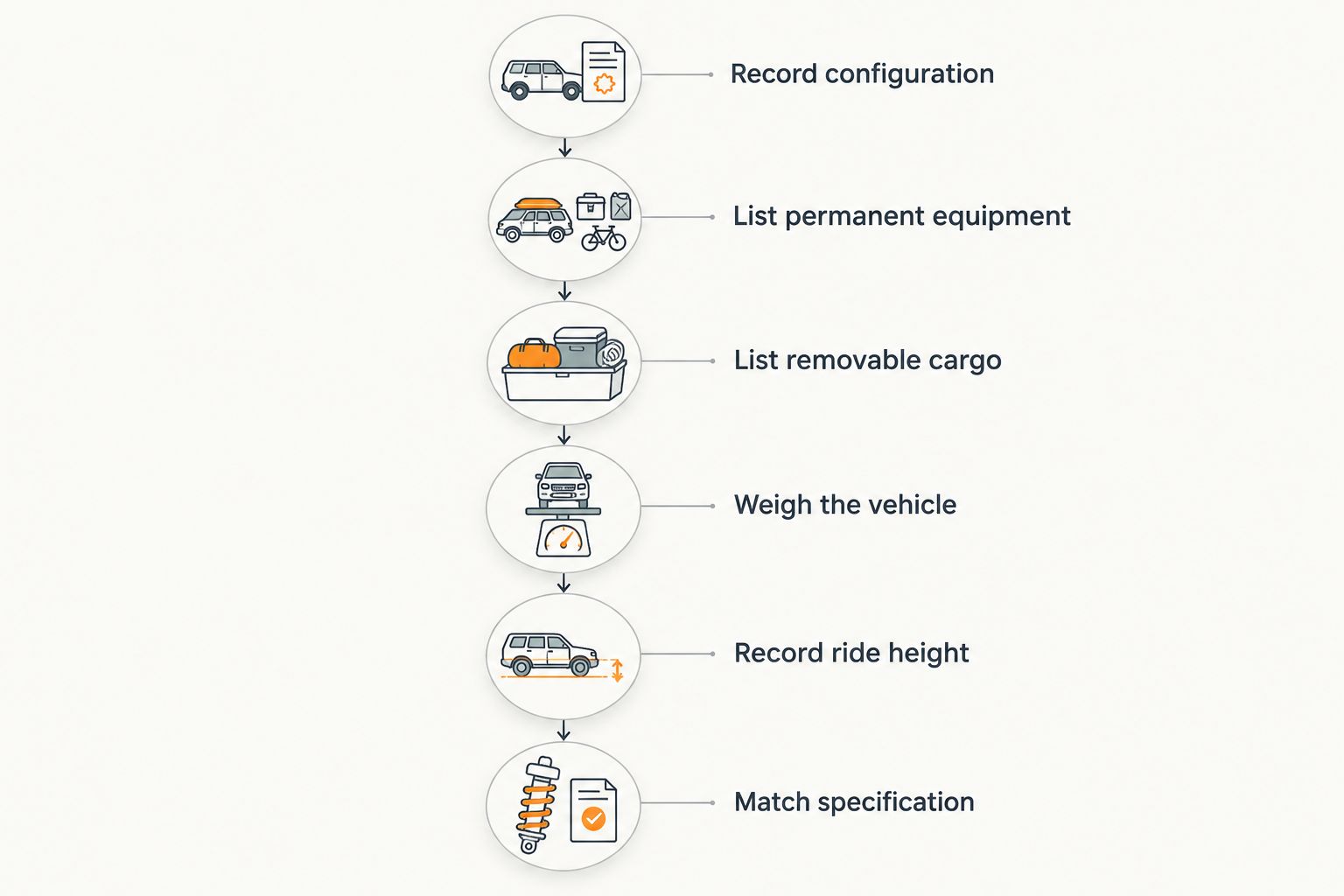
Keep this record after installation. It gives you a baseline when the vehicle gains equipment later, and it makes a follow-up conversation more specific than saying the rear looks low.
Best for: commuting and weekend trips with removable cargo. Select springs for the equipment that normally stays on the SUV, not for a future build that exists only on a shopping list.
A spring intended for substantial permanent weight can leave a lightly equipped vehicle riding higher or feeling firmer than intended. The manufacturer's load application matters more than whether the product description uses terms such as touring or heavy duty.
The advantage is a setup chosen around how you actually drive. The limitation is that adding camping gear still changes suspension position, so evaluate the loaded vehicle before treating the installation as finished.
If permanent armor is only a future possibility, ask whether the proposed kit permits a later spring change. Do not accept an uncomfortable present setup solely to avoid reconsidering springs after the vehicle changes.
Best for: vehicles that keep drawers, armor, and travel equipment installed. Choose the manufacturer's added-load application for the measured configuration, with separate attention to front and rear equipment.
A rear storage system does not establish the correct front spring. Likewise, a front bumper does not justify a heavier rear application unless the rear load also calls for it.
The benefit of a constant-load spring is that its intended working condition includes the specified added weight. The trade-off appears when that weight is removed: the vehicle no longer matches the condition used to select the spring.
For a 2026 build assembled in stages, settle the permanent equipment list before the final spring decision. If installation must happen earlier, explain which accessories are already fitted and which are still planned.
Best for: owners whose travel load changes substantially between trips. Start with springs suited to the normal configuration, then assess the complete vehicle under the heaviest intended legal operating load.
A fixed spring does not make changing cargo disappear. More weight changes its operating position, while removing that weight changes the condition again; the goal is an acceptable setup across your real use, not identical behavior in every situation.
Check passenger and cargo combinations as well as equipment. A solo trip and a family trip can place different demands on the same suspension even when the installed accessories remain unchanged.
Before ordering, describe both conditions to the supplier. Ask what compromises the recommended spring and shock combination makes when empty and when loaded, rather than requesting a universal heavy-load solution.
These factors change the appropriate spring application and the checks required before installation:
Do not compare spring labels across manufacturers as though they share a common scale. A load category is useful only alongside that manufacturer's application details and installation requirements.
Air helpers are not a substitute for correct spring selection or compliance with vehicle weight limits. Consider a helper system only after confirming an exact application for the vehicle, existing suspension, and intended use.
The distinction matters when comparing heavy-duty airbags for loaded 4WDs: correcting loaded stance and increasing a vehicle's permitted operating weight are separate issues. A vehicle sitting level is not proof that its total or axle loads are within their ratings.
For a 4Runner lift kit, ask whether the proposed helper system works with the selected springs and the suspension's full movement. Do not transfer fitment from a Tacoma, Tundra, or another 4Runner generation because the products serve a similar purpose.
A helper system adds its own installation, adjustment, and inspection requirements. Compare those requirements against how often the load changes before adding another component to solve an occasional problem.
Match the shocks to the spring application and installed ride height. Added spring support does not confirm that a shock has suitable compressed and extended lengths for the finished setup.
Have the installer assess bump-stop engagement, available compression and extension travel, and clearance throughout suspension movement. Include brake hoses, wiring, sway-bar components, tires, and nearby hardware in the inspection.
A vehicle that clears its tires while parked has not completed a clearance check. Steering angle and suspension compression change where components sit relative to one another.
For your 2026 installation, also confirm any manufacturer procedures for the factory suspension and related systems. Use the exact application instructions rather than a general installation video covering a different trim.
Heavier springs do not, by themselves, increase the vehicle's rated payload or axle limits. Use the vehicle's labels and owner's manual to identify the applicable limits, then compare them with actual loaded weights.
Accessories consume carrying capacity too. Count installed equipment alongside passengers and cargo rather than treating permanent modifications as weight outside the calculation.
If a loaded axle exceeds its rating, a taller stance does not solve the problem. Remove or redistribute weight as appropriate, reweigh the vehicle, and keep every applicable vehicle and component limit in view.
Ask for more than a side-profile photo when the installation is complete. The finished vehicle needs an inspection in the conditions used to choose the components.
If the rear settles after adding equipment, identify what changed before buying another part. New cargo, a changed permanent load, an installation issue, and component wear call for different responses.
Treat a suspension order from Iron Ridge Offroad as a parts conversation grounded in your vehicle details: provide the exact application, measured load, current equipment, and intended use. Do not treat a catalog label as confirmation that every required component is included.
What springs should I choose for a 4Runner lift kit with camping gear?
Choose springs around the weight your 4Runner carries normally, then assess the vehicle with camping gear loaded. Separate permanent drawers and armor from supplies you remove after a trip.
Do I need heavy-duty springs if I only load my 4Runner on weekends?
Occasional weekend cargo does not automatically justify springs intended for permanent heavy loads. Compare the manufacturer's application with both your daily configuration and loaded axle weights.
Will heavier rear springs make my unloaded 4Runner ride firmer?
Springs selected for substantial permanent weight can feel firmer when that weight is absent. Match the application to the load actually carried and confirm the shock pairing.
Can I use the same spring recommendation on any 4Runner generation?
No, a spring recommendation must match the exact 4Runner application. Confirm model year, trim, factory suspension, and existing modifications before ordering.
Does a 4Runner lift kit increase how much cargo I can carry?
A lift kit does not, by itself, increase the vehicle's rated payload or axle limits. Check the vehicle labels and manual, then weigh the fully loaded SUV.
Should I choose front and rear springs for the same added weight?
Choose front and rear spring applications around their respective loads, not an assumed equal split. Equipment location affects axle loading, so measure both axles.
What information should I send before ordering suspension parts?
Send the exact vehicle configuration, current suspension details, permanent accessory list, measured axle weights, and intended cargo load. Also identify the desired ride height and daily-driving priorities.
Moving existing cargo can change axle loading without changing total vehicle weight. Before replacing springs to correct a loaded stance, review where the equipment sits and confirm that its placement is secure and appropriate.
Save your 2026 load inventory with the suspension part numbers. When the build changes, update that record before assuming the original spring recommendation still applies.