
Built Together.
Your Offroad Partner.
Your Offroad Partner.
Your Offroad Partner.
Your Offroad Partner.

For a Jeep Wrangler JK, Wrangler JL, or Gladiator JT, white underbody rock lights are the best starting point for low-speed trail visibility in 2026. Choose wheel-well lighting for tire-placement checks, separately switched zones for selective coverage, and RGBW lighting when you also want color effects while parked.
Rock lights illuminate the ground beneath and immediately beside your Jeep. They serve a different job from headlights or forward-facing auxiliary lights: showing nearby obstacles when you are moving slowly or working with a spotter.
For your 2026 build, choose the lighting layout before choosing a kit. Iron Ridge Offroad carries aftermarket Jeep parts, but the right lighting purchase still starts with your exact vehicle, existing modifications, and intended mounting locations.
More pods do not fix poor placement. A light hidden behind a tire or exposed directly to a spotter's eyes creates a different result from a protected light aimed at the ground.
Use these criteria to compare kits and decide where they belong:
For a daily driver, these checks also keep an auxiliary-light installation from becoming a maintenance problem. A secure harness matters on the highway as well as on the trail.
These ranked options compare lighting layouts, not interchangeable vehicle-specific kits. The order puts practical trail illumination ahead of decorative effects.
| Rank and layout | Best for | Standout feature | Key limitation |
|---|---|---|---|
| White underbody layout | General low-speed trail use | Ground-focused illumination beneath and beside the Jeep | Poor positioning leaves shadows |
| White wheel-well layout | Tire-placement checks with a spotter | Light concentrated near the tires | Tires and suspension can block the beam |
| Separately switched white zones | Selective coverage on longer vehicles | Independent control of different mounting areas | More wiring and switch planning |
| RGBW underbody layout | Trail use plus parked color effects | Color selection with a dedicated white channel | Controller complexity does not improve placement |
Best for: Jeep owners who want a straightforward crawling-light setup.
A white underbody layout places light on the terrain beneath and beside your Jeep. Start by identifying the areas your headlights cannot show, then locate protected mounting points that illuminate those areas without exposing the light source directly to your spotter.
This is the default recommendation for Jeep rock lights in 2026. Choose it for practical illumination, not as a promise of a particular brightness level or coverage pattern.
White underbody layout pros:
White underbody layout cons:
Before drilling, temporarily position the lights and inspect their coverage after dark. Keep the vehicle stationary on level ground during this check. View the result from the driver's seat and from where a spotter would stand.
Verdict: Buy this layout first for general low-speed trail visibility.
Best for: Drivers who regularly work with a spotter on technical terrain.
Wheel-well lighting directs illumination toward the tires and nearby ground. Its usefulness depends on where the tire sits relative to the light as the steering and suspension move.
Do not treat an illuminated tire sidewall as proof that the obstacle below it is visible. Check the ground coverage, not just the appearance inside the fender.
White wheel-well layout pros:
White wheel-well layout cons:
For a Wrangler JK or JL, inspect the actual liner and fender configuration on your Jeep. Aftermarket fenders, relocated components, and tire changes alter the available space; a generation label alone does not establish clearance.
Verdict: Buy for tire-focused coverage; skip as the only layout if the center remains dark.
Best for: Gladiator JT owners and other buyers who need independent lighting areas.
A zoned layout separates mounting areas into independently controlled circuits or controller outputs. Depending on the selected equipment, you can organize front, center, and rear coverage rather than switching every light together.
A Gladiator JT deserves its own layout assessment. Do not copy a Wrangler mounting diagram and assume it covers the pickup's underbody and rear area.
Separately switched white zones pros:
Separately switched white zones cons:
Before choosing hardware, draw the mounting areas and their cable routes. Identify which lights must work together, then confirm that the harness or controller supports that arrangement without improvised connections.
Verdict: Buy when independent control solves a real need; hold for simpler builds.
Best for: Owners who want white ground lighting plus selectable colors while parked.
RGBW denotes red, green, blue, and white lighting channels. A dedicated white channel distinguishes this layout from RGB-only equipment that mixes colors to produce a white appearance.
For a 2026 purchase, inspect the manufacturer's description of the white channel and its controls. The RGBW label does not establish beam coverage, sealing, connector quality, or vehicle fitment.
RGBW underbody layout pros:
RGBW underbody layout cons:
Prioritize access to white light over complicated effects. Confirm whether the system remembers its previous setting and whether a physical switch provides the operation you need.
Verdict: Buy for deliberate mixed use; skip if you only need trail illumination.
White underbody lighting ranks first because its purpose directly matches general ground visibility. Wheel-well lighting takes the tire-placement slot, separately switched zones address control, and RGBW addresses mixed functional and decorative use.
This is a selection framework, not a measured comparison of individual kits. At Iron Ridge Offroad, Jeep rock lights belong in the same fitment-led buying process as other vehicle upgrades: match the part and installation requirements to the Jeep, not the other way around.
Record your Jeep's model year, generation, body configuration, and current modifications. Then assess these areas in order:
A 2-door Wrangler and a 4-door Wrangler need separate routing assessments. Likewise, a Jeep with a 3-inch lift does not automatically have a safe mounting location simply because it has more static clearance.
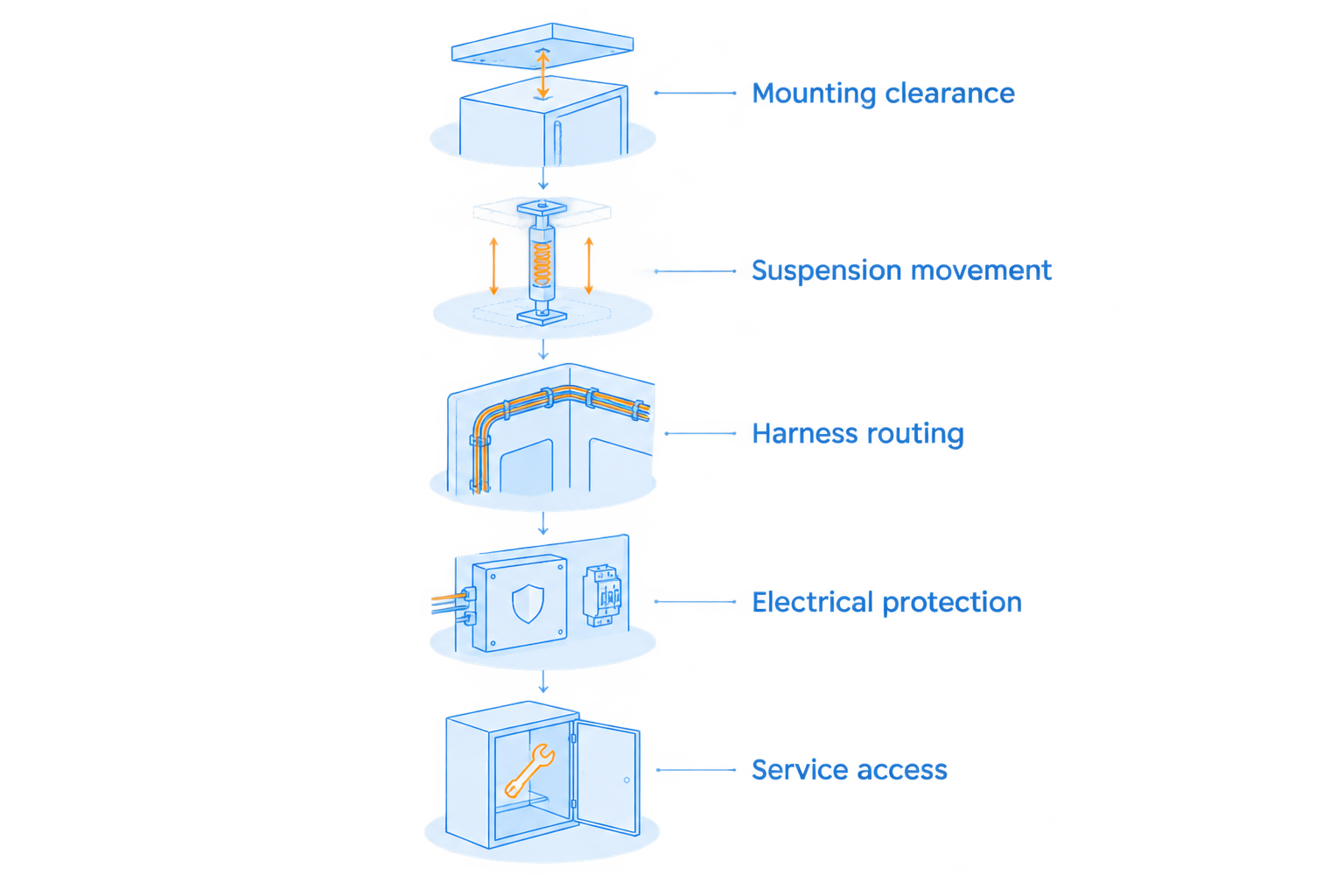
Do not borrow electrical specifications from another kit. A 12-volt system label does not establish the correct fuse or cable size, and a controller rating does not confirm the capacity of an existing accessory circuit.
Rock lights show nearby ground; forward-facing lights illuminate the route ahead. Choose each system for its own job rather than expecting one to replace the other.
The distinction also explains why LED light bars for off-roading need a separate beam-pattern and mounting decision: a forward-facing beam does not provide deliberate underbody coverage. Adding more forward output leaves the areas beneath the chassis dependent on a different lighting layout.
Keep those functions independently controlled where the selected equipment supports it. You should not need forward-facing trail lights on simply to inspect ground beside the Jeep while stopped.
For public-road use in 2026, check the applicable state and local rules before operating auxiliary lighting. Color, placement, and permitted use are separate questions from whether a kit physically fits.
A useful product description identifies more than colors and a pod count. Look for mounting dimensions, electrical requirements, harness contents, control method, and documented environmental ratings.
Read the sealing information carefully. An IP67 rating and an IP68 rating are different classifications under IEC 60529; neither label alone explains every connector's protection or authorizes pressure-washing the installation at close range. Follow the manufacturer's stated conditions.
Ask these questions before ordering:
Iron Ridge Offroad buyers should identify unresolved installation requirements before selecting additional accessories. Buy the missing component because the instructions require it, not because another Jeep build used it.
Choose white underbody lights unless a specific use case justifies another layout. Add wheel-well coverage for tire-placement checks, select independent zones when you need area control, and choose RGBW when parked color effects are part of the plan.
Keep the 2026 buying decision simple: documented fitment, useful ground coverage, protected mounting, and a complete electrical plan come before decorative features. A smaller, correctly positioned setup is a better starting point than an elaborate layout with unresolved clearance or wiring.
What's the best type of Jeep rock lights for trail driving?
White underbody rock lights are the best starting layout for general low-speed trail visibility. Add focused wheel-well coverage only where your actual installation leaves tire-placement areas dark.
Do Jeep rock lights fit both Wrangler JK and JL models?
Do not assume a mounting kit fits both Wrangler JK and JL models. Confirm the exact kit's applications, mounting provisions, and clearance requirements for your Jeep and its modifications.
Are RGBW rock lights better than white rock lights?
RGBW rock lights are better suited to buyers who also want selectable colors while parked. For trail-only illumination, prioritize usable white coverage and installation quality rather than color effects.
How many rock lights does a Jeep need?
Choose the light count from the coverage your Jeep needs, not a universal pod-count rule. Temporarily position the lights and inspect shadows around the tires, chassis, and rear area before final mounting.
Can I connect rock lights to factory auxiliary switches?
Use factory auxiliary switches only when the vehicle instructions and lighting-kit requirements support the connection. Check circuit capacity, required fusing, controller compatibility, and whether a relay is specified.
Are Jeep rock lights legal on public roads?
Public-road legality depends on the applicable state and local rules. Check restrictions covering color, placement, and operation before using auxiliary underbody lighting on the road.
Does an IP68 rating mean the entire installation is waterproof?
An IP68 rating does not establish the protection of every part of an installed lighting system. Check which components carry the rating and follow the manufacturer's stated immersion and installation conditions.
Before tightening the final brackets, inspect the lights from your spotter's position. If the light source shines into the spotter's eyes instead of onto the obstacle, change the mounting angle or location. Ground lighting should help the person guiding you, not just look bright from beside the Jeep.