
Built Together.
Your Offroad Partner.
Your Offroad Partner.
Your Offroad Partner.
Your Offroad Partner.

Best overall: bolt-on, frame-mounted Tacoma rock sliders for a daily driver that sees rocky trails. Best for easier entry: frame-mounted sliders with integrated tread; best for a custom build: weld-on sliders installed to the manufacturer's requirements. This 2026 guide ranks slider configurations by protection, fitment, everyday access, and installation demands—not appearance.
Your Tacoma's rocker panels sit below the doors, where an obstacle can contact the body between the tires. A running board provides a foothold; that function alone does not establish that it can support the truck against a rock.
Buy protection for the obstacles you encounter, not for the stance you want. If suspension changes are also on your list, read the Tacoma lift kit guide for daily use and trails. Suspension height and rocker protection solve different problems.
For a 2026 Tacoma, confirm the exact cab, bed, powertrain, and factory equipment before ordering. A Tacoma nameplate match is not a complete fitment check.
Use these criteria before comparing shapes or finishes:
Iron Ridge Offroad's Tacoma rock sliders recommendation is simple: choose documented rocker protection before step convenience. A wide platform and aggressive styling do not substitute for an appropriate mounting system.
These rankings compare configurations, not interchangeable products. Each purchase still needs an application-specific fitment check.
| Rank and configuration | Best for | Standout feature | Key limitation |
|---|---|---|---|
| 1. Bolt-on frame-mounted sliders | Daily drivers with recurring rock contact | Removable frame attachment without a weld-on installation | Bolt-on does not automatically mean no drilling |
| 2. Frame-mounted sliders with integrated tread | Trucks carrying passengers who need a usable foothold | Rocker protection and an entry surface in one assembly | Wider or lower tread changes obstacle clearance |
| 3. Weld-on frame-mounted sliders | Custom builds with a planned fabrication installation | Mounting arranged around a documented weld-on design | Installation and later removal require fabrication work |
A kickout, tread plate, or angled outer tube can appear in more than one configuration. Treat those as secondary choices after fitment and mounting—not separate proof of strength.
Bolt-on frame-mounted sliders are the default starting point when you drive your Tacoma during the week and encounter rocks on weekends. They attach through a product-specific bracket and hardware arrangement rather than relying on a step's appearance to imply protection.
Choose a design whose manufacturer explicitly identifies its intended protective use. Read the installation instructions before ordering; the term bolt-on describes the fastening method, not every installation requirement.
Bolt-on frame-mounted slider pros:
Bolt-on frame-mounted slider cons:
Best for: A daily-driven Tacoma whose owner wants documented rocker protection without committing to welded mounts.
Do not choose a kit solely because it uses existing holes. Confirm which holes, brackets, and fasteners the installation requires, and check whether previous modifications occupy those locations.
Verdict: Buy a bolt-on frame-mounted configuration when the manufacturer confirms your exact application and intended trail use.
Frame-mounted sliders with integrated tread combine a protective structure with a surface for getting into the cab. The tread can make the assembly more useful during ordinary errands, especially when passengers struggle to reach the floor.
The important distinction is structural: an integrated step belongs on a documented slider assembly. A running board does not become a rock slider because its platform is metal or its finish looks trail-oriented.
Integrated-tread slider pros:
Integrated-tread slider cons:
Best for: A Tacoma that encounters rocky trails but also needs a practical foothold for regular passengers.
For your 2026 shortlist, compare where your foot lands relative to the door opening. A surface that is easy to see in a product photo is not necessarily positioned where you naturally step.
Verdict: Buy integrated-tread sliders when daily access matters, but reject a design that places the foothold below your acceptable clearance line.
Weld-on sliders use fabricated attachments installed according to the slider manufacturer's requirements. They suit a build where welding is a deliberate part of the plan, rather than a workaround for an incompatible bolt-on kit.
Welding alone does not establish better protection. Attachment design, materials, preparation, and installation quality all matter; compare the documented assembly instead of treating the mounting method as a strength rating.
Weld-on slider pros:
Weld-on slider cons:
Best for: A custom Tacoma build with a qualified fabricator and a manufacturer-supported weld-on installation plan.
Agree on positioning, door clearance, and coating work before installation starts. Also establish how the installer will protect nearby vehicle components during fabrication.
Verdict: Hold until a qualified installer confirms the design and installation procedure for your truck.
Start your 2026 Tacoma rock sliders search with the truck's exact configuration. Then compare that information with the manufacturer's application listing and installation instructions.
Use this sequence:
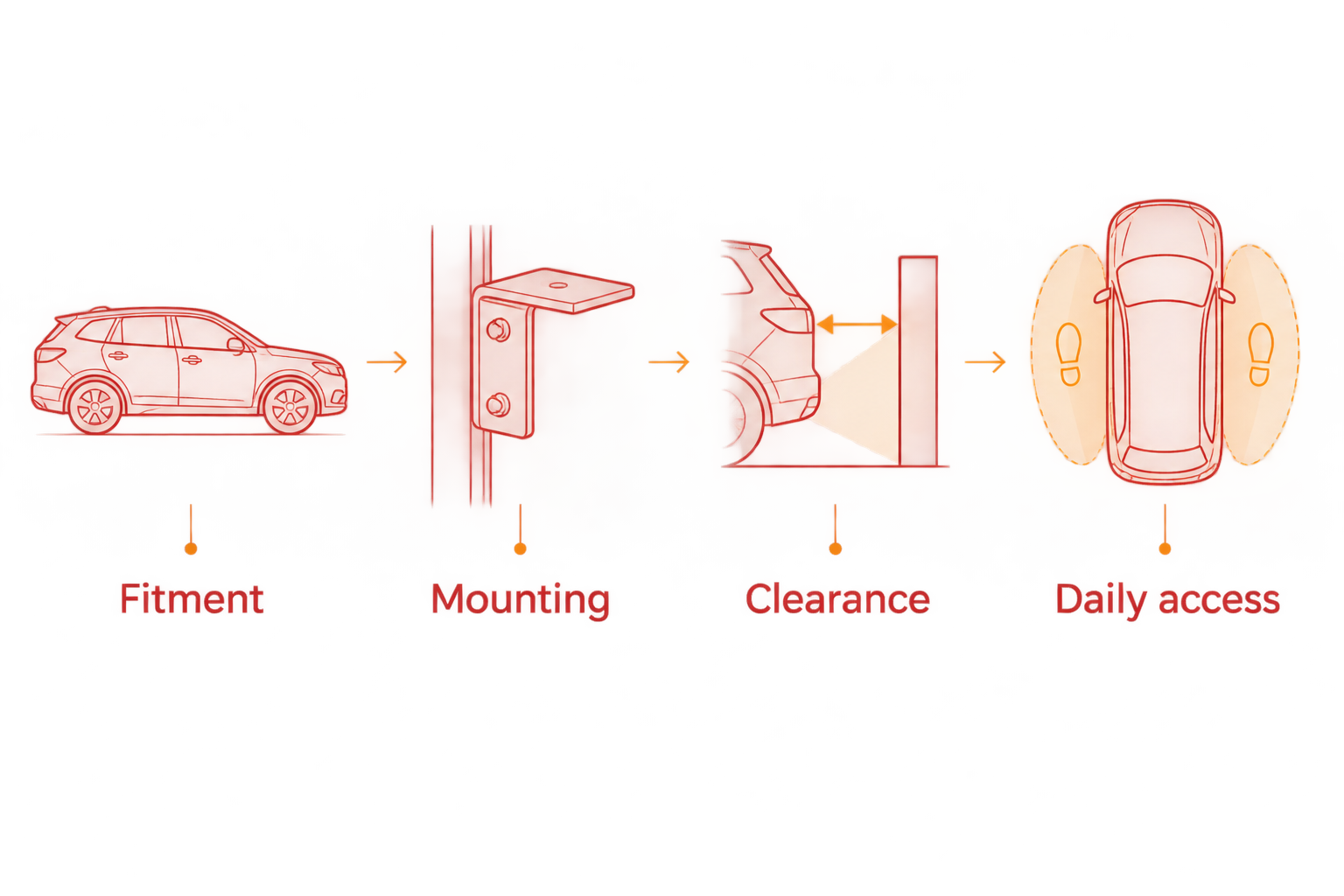
Engine details help identify the application, but they do not prove slider compatibility. A listing for a 2016–2023 Tacoma 3.5-liter vehicle and one for a 2026 Tacoma 2.4-liter vehicle describe different applications; never transfer fitment between them without explicit manufacturer confirmation.
Cab and bed details matter just as much. For example, the N-Fab T1589CC-TX listing identifies a 2016–2023 Tacoma Double Cab with a 6-foot bed, but identifies the product as nerf steps. That application detail does not establish rock-slider performance or fitment for another truck.
Do not order from a generation label alone. If the product listing and installation instructions disagree, resolve the discrepancy before purchase.
A tucked-up profile prioritizes clearance rather than a low foothold. Choose it when you want the slider close to the rocker area and do not need it to function like a running board.
The trade-off is access. Ask whether you can place your foot securely without catching a shoe beneath the door or stepping on a narrow, awkward surface.
A tread surface gives your foot a defined landing area. Compare texture, openings, edge shape, and position beneath the door rather than judging the platform by width alone.
The trade-off is packaging. An easier-to-reach surface can sit farther out or lower, so check its position against the obstacles your truck encounters.
A rear kickout changes the outer profile near the back of the slider. Evaluate its location relative to the body and rear tire, along with the manufacturer's explanation of its intended function.
The trade-off is extra projection. Check whether that shape suits your usual trail lines, parking spaces, and entry habits instead of assuming every Tacoma needs one.
Before placing a 2026 order, read the complete installation procedure—not just the product description. Confirm whether the assembly replaces existing steps and whether all required brackets and hardware are identified.
Send the seller a concise fitment request:
Ask for clarification whenever the instructions require moving lines, removing equipment, or modifying an attachment area. Do not improvise around a conflict.
After installation, follow the manufacturer's tightening and inspection instructions. Never use a slider as a lifting or recovery point unless its manufacturer explicitly permits that use and specifies the procedure. Rock-contact protection, jacking, and vehicle recovery are different demands.
The order prioritizes documented protective use, exact fitment, everyday practicality, and installation demands. Bolt-on frame-mounted sliders take the default slot because they address trail protection without requiring a welded installation; integrated-tread sliders move ahead when passenger access drives the decision.
Weld-on sliders remain a specialist choice. This is a configuration guide, not a claim that one named slider has outperformed another in impact testing.
Choose bolt-on, frame-mounted sliders as your starting point for a daily-driven Tacoma that encounters rocks. Move to integrated tread when entry is a recurring problem, and reserve weld-on designs for a planned fabrication build.
Iron Ridge Offroad recommends making that decision in this order: exact fitment, documented protective function, mounting requirements, then access features. Finish and appearance come last.
What's the best type of Tacoma rock slider for a daily driver?
Bolt-on, frame-mounted Tacoma rock sliders are the starting point for a daily driver that encounters rocky trails. Choose an application-specific design with documented protective use, then decide whether you need integrated tread.
Are Tacoma running boards the same as rock sliders?
No. Running boards provide a foothold, while rock-slider suitability depends on the product's structure, attachment, and documented intended use. Do not assume a metal running board can support vehicle contact with an obstacle.
Will older Tacoma rock sliders fit a 2026 Tacoma?
Do not assume older Tacoma rock sliders fit a 2026 Tacoma. Buy only when the manufacturer explicitly lists your model year and configuration, including relevant cab, bed, and equipment requirements.
Are bolt-on Tacoma sliders better than weld-on sliders?
Bolt-on sliders are the default choice when you want documented protection without a welded installation. Weld-on designs suit planned fabrication builds; the mounting method alone does not establish greater strength.
Do Tacoma rock sliders need a kickout?
A kickout is an optional profile choice, not a universal requirement. Compare its position near the body and rear tire with the manufacturer's intended use and your trail-clearance needs.
Can I jack up my Tacoma using a rock slider?
Use a Tacoma rock slider as a jacking point only when its manufacturer explicitly authorizes it. Follow the specified lifting procedure and equipment requirements rather than treating protective construction as lifting approval.
What should I check before ordering Tacoma rock sliders?
Confirm model year, cab, bed, powertrain, mounting requirements, and clearance around existing equipment. Read the installation instructions and resolve any conflict between those instructions and the application listing before ordering.
Check whether the seller is offering a complete vehicle set, a single side, or separate mounting components. A product photo can show an installed assembly without settling what the order includes.
For your 2026 build, ask Iron Ridge Offroad to confirm the manufacturer's part number and application before ordering. The right slider is the one documented for your truck and intended use—not the one that merely looks strongest.