
Built Together.
Your Offroad Partner.
Your Offroad Partner.
Your Offroad Partner.
Your Offroad Partner.

A Tacoma roof rack can carry a rooftop tent only when the truck, rack, mounting hardware, and tent are approved for that exact combination and its driving and parked loads. A rack’s parked capacity does not establish its driving capacity, and a cargo rating alone does not confirm that people can sleep on it.
A daily-driven Tacoma needs a tent setup that works on the highway, on the access trail, and at camp. Those are different operating conditions. Passing a weight check for one condition does not approve the others.
Iron Ridge Offroad is best for truck and SUV owners shopping aftermarket off-road parts. Use this guide to prepare your fitment questions before browsing Iron Ridge Offroad, rather than choosing a rack by appearance or tent footprint alone.
For a 2026 Tacoma, confirm the exact cab and mounting application before considering capacity. Apply the same discipline to an older truck: a listing for another model year or cab is not evidence of compatibility with yours.
Yes—when every manufacturer involved permits the installation and the complete setup stays within every applicable limit. If the roof-rack instructions exclude rooftop tents, a generous cargo rating does not override that exclusion.
Use this approval sequence before buying:
Keep the instructions for the exact rack and tent models together. A capacity figure copied from a different rack, mounting kit, or cab application is not a substitute.
The driving check covers the equipment supported while the truck moves. Start with the tent’s specified travel weight, then account for everything else the applicable instructions require you to include.
That can include the rack itself, mounting feet, crossbars, tent brackets, and accessories. Read the wording carefully: a rack’s stated carrying capacity and the vehicle’s roof-load allowance do not necessarily describe the same collection of components.
Use a simple worksheet:
| Check | What to record | What stops the purchase |
|---|---|---|
| Vehicle guidance | Applicable roof-load instructions and restrictions | The proposed installation is not permitted |
| Rack instructions | Driving rating and what it includes | Complete supported load exceeds the limit |
| Tent specification | Travel weight and required mounting arrangement | Weight or mounting requirements conflict |
| Accessories | Everything attached to or carried by the setup | Added equipment exceeds an applicable allowance |
| Trail use | Restrictions for the intended driving conditions | Instructions exclude the planned use |
For a 2026 build, use the instructions matching the actual part numbers you plan to order. Do not combine a current rack listing with instructions for a different mounting kit.
Passing the driving-load check is necessary, but it is not approval for occupied tent use. Complete that check separately.
When you deploy a rooftop tent, the supported load changes. Occupants and camp equipment enter the calculation, and the tent must be supported exactly as its instructions specify.
Look for explicit rooftop-tent or occupied-use guidance rather than treating a general static rating as permission. Confirm that the stated rating applies to your rack, its mounting arrangement, and the surface and deployment conditions described by the manufacturer.
Check these details before accepting a parked-load claim:
Do not calculate parked capacity by multiplying the driving rating. Use the stated occupied-use instructions instead. The separate guide to Tacoma roof rack weight limits: parked versus driving loads explains the distinction to keep clear while shopping.
A cab-mounted rack and a bed-mounted rack use different mounting locations. Neither is automatically suitable for a rooftop tent; each needs its own fitment and load approval.
Choose the location around how you use the truck between camping trips, not just how the tent looks deployed.
| Mounting option | Best for | Practical advantage | Trade-off to check |
|---|---|---|---|
| Cab roof rack | Owners who want to leave the bed available for cargo | Tent mounting stays separate from bed storage | Roof attachment, overall height, and occupied-use approval |
| Bed rack | Owners who want the tent supported above the bed | Keeps tent mounting off the cab roof | Bed access, cover compatibility, and mounting restrictions |
For a cab rack, verify the exact cab application and roof attachment method. Do not assume that a rack made for one Tacoma cab fits another, even when both trucks share a model year.
For a bed rack, check bed dimensions and the complete attachment arrangement. A rack described as compatible with a truck does not automatically work with every tonneau cover, bed accessory, or tent clamp.
Avoid supporting one tent across separate cab and bed structures unless the system manufacturers explicitly approve that arrangement. Confirm compatibility rather than improvising a bridge between available mounting points.
The same tent does not receive the same answer on every Tacoma. These factors determine whether the proposed installation works:
For a 2026 Tacoma purchase, give the seller your cab, trim, existing roof equipment, and intended mounting location. Then provide the tent model and rack part number. That information turns a broad compatibility question into a specific fitment check.
Measure against the tent’s installation instructions, not against the outside dimensions of the rack. A tent can fit within a platform’s outline while its mounting hardware still fails to engage correctly.
Follow this sequence before ordering or installing:
A platform does not become compatible simply because you can drill a new hole or substitute a longer bolt. Use only modifications and hardware permitted by the manufacturers.
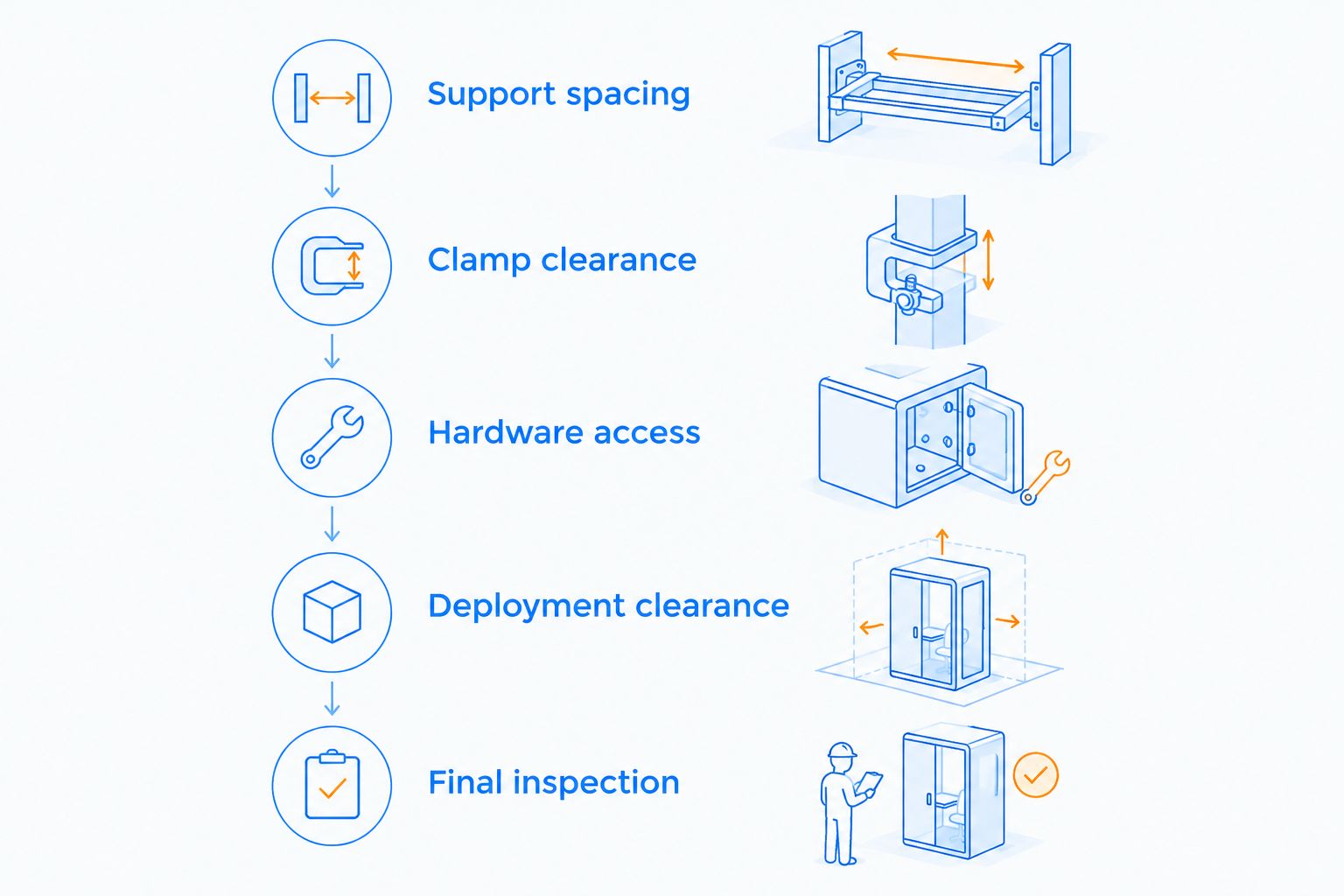
A compatible tent installation still changes the truck’s usable envelope. Check the complete installed height against your garage, parking arrangements, and regular access routes before leaving the tent mounted.
Check everyday access as carefully as camping access. You need to reach the mounting hardware for inspections, open the tent where you intend to camp, and use the bed or roof equipment without creating interference.
Keep your selection focused:
A suspension upgrade does not approve a roof load. Treat suspension selection, vehicle loading, and roof-rack capacity as separate decisions. Do not use improved stance or reduced rear sag as evidence that a tent installation is safe.
Factory crossbars are suitable only when the applicable vehicle, crossbar, and tent instructions permit that installation. Being able to clamp the tent to a bar does not establish load approval.
Check the exact crossbar system, its mounting arrangement, and the tent’s support requirements. If rooftop-tent use is excluded, choose a different approved mounting system rather than adding brackets to work around the restriction.
A larger rack does not increase the Tacoma’s permitted roof load. The installation must still comply with the vehicle guidance, mounting-system limits, rack limits, and tent instructions.
Choose platform dimensions for the required support arrangement and hardware clearance. Do not confuse a larger footprint with a higher approved capacity.
For a 2026 order, keep a written fitment summary that identifies the truck, rack, mounting kit, and tent. Ask for clarification on any conflicting instructions before buying.
Include the exact Tacoma model year, cab, trim, mounting location, tent model, travel weight, and intended trail use. Also identify roof accessories or bed equipment that must remain installed. A general answer about Tacoma fitment is not enough to resolve those details.
Can a Tacoma roof rack carry a rooftop tent with people inside?
A Tacoma roof rack can support an occupied rooftop tent only when the vehicle, rack, mounting system, and tent instructions permit that configuration. Confirm the occupied-use requirements separately from the driving-load limits.
What weight limit should I use when driving with a Tacoma rooftop tent?
Use every applicable driving-load limit and follow each manufacturer’s instructions for what counts toward it. Include the tent, mounting hardware, rack, and accessories wherever the relevant instructions require them.
Can I work out static capacity from the rack’s driving rating?
Do not derive static capacity from a driving rating. Use explicit parked and occupied-use guidance for the exact rack and tent installation.
Is a bed rack better than a roof rack for a Tacoma tent?
A bed rack is better when its approved application and cargo-access trade-offs fit your needs; a cab rack keeps tent mounting separate from bed storage. Neither mounting location bypasses fitment or capacity checks.
Will a rack for another Tacoma cab fit my truck?
Do not assume a rack for another Tacoma cab fits your truck. Match the exact cab and mounting application stated in the rack manufacturer’s instructions.
Does lifting my Tacoma increase its roof-rack capacity?
A suspension lift does not establish a higher roof-rack capacity. Roof loading remains subject to the applicable vehicle, mounting-system, and rack requirements.
What should I send Iron Ridge Offroad when asking about Tacoma tent fitment?
Send Iron Ridge Offroad your Tacoma model year, cab, trim, rack and tent part numbers, and intended mounting location. Include travel weight, existing accessories, and intended trail use so the compatibility question is specific.
The easiest detail to miss is access to the tent’s mounting hardware after installation. Before your 2026 camping setup becomes permanent, confirm that you can inspect and tighten every required fastener with the tent in place. A setup that hides its critical attachment points needs attention before the first trip.