
Built Together.
Your Offroad Partner.
Your Offroad Partner.
Your Offroad Partner.
Your Offroad Partner.

For a truck or SUV off road recovery kit, choose a kinetic recovery rope for manufacturer-approved dynamic recoveries and a tow strap for steady towing when its instructions permit that use. A low-stretch tow strap is not a substitute for a kinetic rope when using vehicle momentum. Neither belongs in a recovery system without suitable attachment points, compatible connectors, and a clear plan for keeping people away from loaded equipment.
A daily-driven pickup can carry passengers, tools, armor, and camping equipment when it reaches the trail. That loaded vehicle is the one your recovery equipment must suit—not an empty version of the same model.
The wrong pulling method also changes the forces involved. Before buying individual components, use the off-road recovery kit packing guide to plan the equipment around your actual trail use.
For your 2026 kit, treat the rope, connectors, attachment points, and recovery method as one system. A strong rope cannot correct an unsuitable connection.
Choose by the task: kinetic rope for a controlled dynamic recovery, tow strap for permitted steady towing. Product instructions decide the application; appearance and naming do not.
| Equipment | Best for | Main advantage | Main limitation | Buying check |
|---|---|---|---|---|
| Kinetic recovery rope | Trained vehicle-to-vehicle dynamic recovery where conditions permit | Designed to stretch and transfer stored energy during recovery | Stores energy and requires a suitable recovery area and compatible equipment | Confirm the manufacturer's vehicle-weight guidance and recovery procedure |
| Conventional low-stretch tow strap | Steady towing of a vehicle that can roll, where permitted | Provides a connection for a controlled, steady pull | Not intended for momentum-based snatching | Confirm towing use, ratings, end fittings, and vehicle instructions |
| Elastic recovery strap | Dynamic recovery when explicitly approved by its manufacturer | Provides designed stretch in a flat strap format | Easily confused with a conventional tow strap | Read the label and instructions rather than judging by shape |
A flat strap can be an elastic recovery strap or a low-stretch towing strap. Likewise, a rope's braided construction does not establish its intended use. Read the product's stated application before putting it in your kit.
Do not make a dynamic pull with an unidentified strap. If the label is unreadable or the instructions are unavailable, remove that item from the recovery plan until its specification is confirmed.
A kinetic recovery rope stretches under load and releases stored energy as it contracts. That behavior is the reason to select it—and the reason to keep people clear of the system.
The rope alone does not make a recovery appropriate. Both vehicles need attachment points approved for the intended loading, compatible connectors, and operators who understand the manufacturer's procedure.
A kinetic rope provides deliberate elasticity during a vehicle-to-vehicle recovery. It is an option when the recovery conditions, available space, vehicle positions, and equipment instructions support that method.
Select the rope using its manufacturer's guidance for the vehicles involved. Do not assume the thickest rope is automatically the right match; its operating characteristics must suit the application.
Skip a dynamic recovery when you cannot establish suitable attachment points, clear people from the danger area, or position the vehicles as required. Stop if the vehicle is unstable or the recovery path creates an unacceptable risk.
Do not solve an unsuccessful recovery by adding speed. Reassess why the vehicle is stuck, reduce resistance where safe, and change the recovery plan when necessary.
For a 2026 purchase, prioritize readable ratings, application guidance, and accessible instructions over color, storage-bag design, or an oversized headline strength claim.
A conventional tow strap connects vehicles for a steady pull when the strap and vehicle manufacturers permit that use. Its purpose is not to store and release substantial energy through deliberate stretch.
This makes the intended task critical. Towing a freely rolling vehicle is different from pulling a vehicle held by deep mud, an obstacle, or another source of resistance.
A suitable tow strap provides a connection for controlled towing without treating momentum as the recovery mechanism. Confirm that both vehicles can be operated and controlled as the towing procedure requires.
Check the vehicle owner's manual before towing. Drivetrain restrictions, steering operation, braking assistance, and permitted towing methods affect whether a strap-based tow is appropriate at all.
A low-stretch tow strap is not a snatch strap. Taking a run at a stuck vehicle with one can expose the equipment and attachment points to abrupt loading outside the intended use.
A tow strap also does not make public-road towing legal or suitable. Check applicable rules and the vehicle's towing instructions; use professional recovery when the situation exceeds the equipment or your ability to control it.
The correct setup depends on more than whether you drive a Bronco, Wrangler, Tacoma, or heavy-duty pickup. Match the following factors before choosing equipment:
Keep lift height separate from recovery suitability. Suspension upgrades and larger tires do not establish that a bumper, loop, receiver, or mounting bracket is approved for dynamic recovery.
Start with the vehicle owner's manual and the attachment-point manufacturer's instructions. A shipping tie-down, transport loop, or convenient opening is not automatically a recovery point.
For Iron Ridge Offroad recovery-gear buyers, the useful starting question is whether the connection suits the exact vehicle and intended pulling method. Then select the rope and connector around that approved arrangement.
The IAG FMS recovery point set is a relevant product to investigate at this stage. Confirm its exact application, installation requirements, and permitted recovery use before ordering; the product name alone does not establish compatibility with your truck or SUV.
Never attach a recovery rope or strap to a trailer hitch ball. It is not an appropriate attachment point for this task, and a failed connection can become a projectile.
A receiver opening is not blanket approval either. Use only an attachment arrangement explicitly suitable for the intended recovery, following the vehicle and component manufacturers' directions.
A winch mounting system supports a different part of the recovery setup. Do not assume its presence approves nearby bumper openings or brackets for a rope pull.
If you are planning a winch installation, assess the IAG I-Line heavy-duty winch mount against its own vehicle and winch requirements. Treat that fitment check separately from selecting vehicle-to-vehicle recovery connections.
Build the kit in this order so every purchase answers a specific requirement. This is a selection process, not a substitute for hands-on recovery instruction.
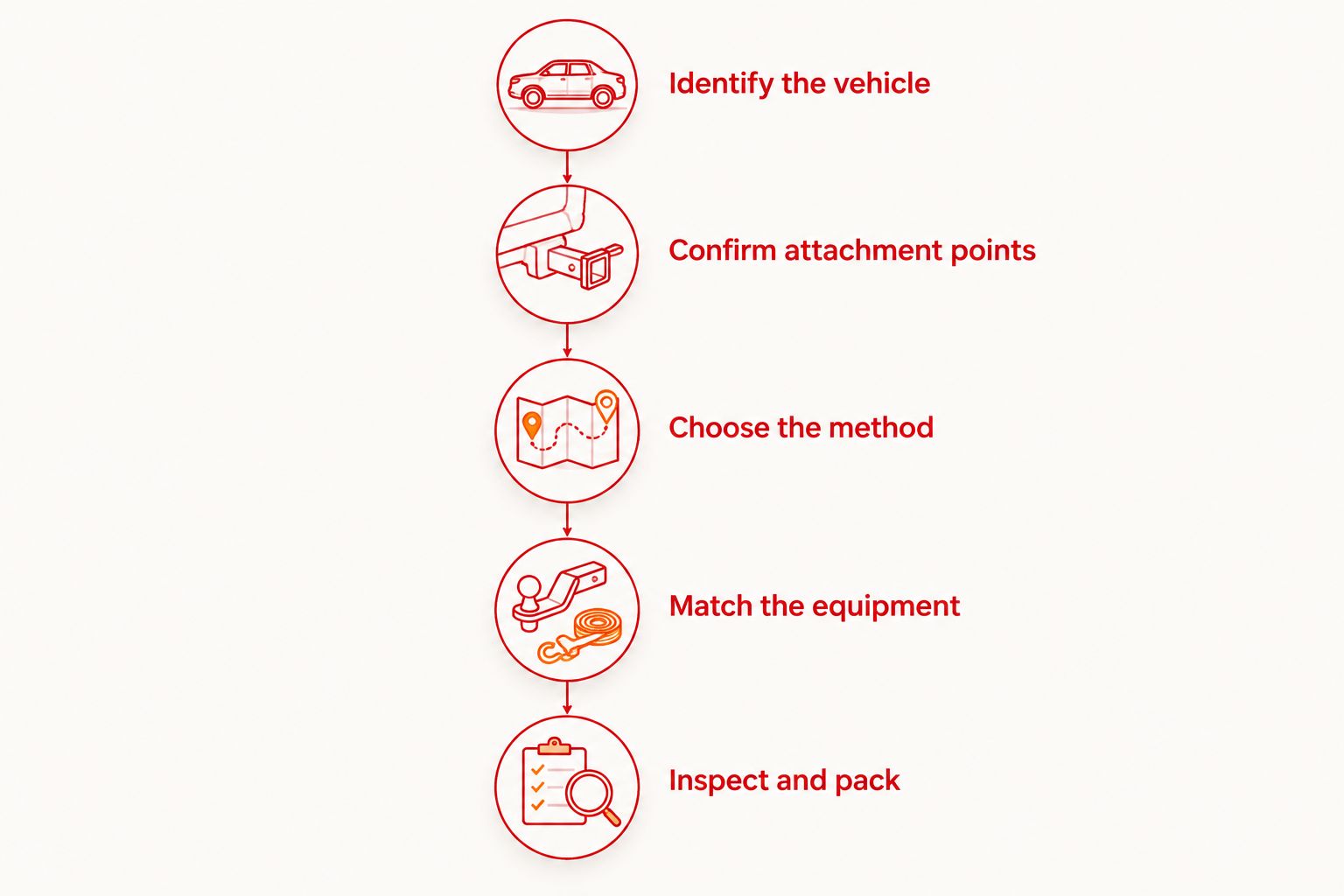
Ask your trail partners about their equipment before departure. A kit that depends on someone else's vehicle also depends on that vehicle having a compatible, approved connection and a driver who understands the plan.
Carry both only when you have a defined use for each and can distinguish them immediately. They serve different tasks; carrying both does not make them interchangeable.
Keep their labels visible and their instructions accessible. Store unidentified equipment separately until you confirm its purpose, rather than leaving it available for a hurried choice during a recovery.
For a 2026 weekend-trail kit, start with approved connections and the equipment your planned trips require. Add another pulling tool because it solves a real task, not because a larger bag looks more complete.
No. Breaking strength does not by itself establish the correct vehicle match, permitted recovery method, or safe connection arrangement.
A minimum breaking strength and a working load limit describe different things. Do not compare them as equivalent ratings or calculate your own operating limit without the manufacturer's guidance.
Check the terminology on every component. If the rating or intended application is unclear, resolve it before use rather than assuming the largest printed figure makes the system suitable.
What's the best off road recovery kit for a daily-driven truck?
The best off road recovery kit matches your truck's approved attachment points, loaded vehicle weight, and intended recovery method. Choose a kinetic rope for approved dynamic recovery or a tow strap for permitted steady towing, rather than treating either as a universal solution.
Is a kinetic rope better than a tow strap?
A kinetic rope is better suited to approved dynamic recovery; a conventional tow strap is suited to permitted steady towing. The correct choice depends on the task, not a general ranking of rope against strap.
Can I use a tow strap to yank a truck out of mud?
Do not use a conventional low-stretch tow strap for a momentum-based pull. Use only equipment explicitly intended for the planned recovery method, with suitable attachment points and the manufacturer's procedure.
How do I know whether my flat strap is a recovery strap?
Read the strap's label and manufacturer instructions to establish its intended use. Flat construction alone does not distinguish an elastic recovery strap from a low-stretch tow strap.
Can I attach a recovery rope to my hitch ball?
Never attach a recovery rope to a trailer hitch ball. Use an attachment arrangement explicitly approved for the intended recovery and follow the vehicle and component instructions.
Do soft shackles work with every recovery point?
Soft shackles do not suit every attachment point. Confirm the connector manufacturer's requirements for bearing surfaces, edge protection, ratings, and the specific connection arrangement.
Should I replace a recovery rope that looks damaged?
Remove damaged recovery equipment from service and follow its manufacturer's inspection and retirement criteria. Do not rely on an improvised repair or assume that an intact outer section proves the rope is serviceable.
What should I check before ordering recovery gear from Iron Ridge Offroad?
Confirm the exact vehicle application, approved attachment method, component ratings, and installation instructions before ordering recovery gear from Iron Ridge Offroad. Check compatibility across the entire system rather than approving each part in isolation.
The connection deserves as much attention as the rope. Before your next 2026 trail trip, identify the approved attachment points on your own vehicle and review how you would reach them when stuck.
Do that check while the truck is clean and parked safely. Discovering an unsuitable or inaccessible connection after the vehicle is immobilized is the wrong time to redesign the kit.