
Built Together.
Your Offroad Partner.
Your Offroad Partner.
Your Offroad Partner.
Your Offroad Partner.

A 4Runner lift kit with KDSS must explicitly support your vehicle’s model year and KDSS equipment, not just the 4Runner name. Before buying in 2026, confirm the kit’s suspension-travel limits, stabilizer-bar clearance, required supporting parts, and installation procedure; a general fitment listing does not settle those checks.
Choose a kit whose manufacturer explicitly lists your exact 4Runner application with KDSS and supplies installation instructions for that configuration. The approval must cover the complete combination you intend to install, including shocks, springs, spacers, control arms, and any required brackets.
Start with the broader 4Runner lift kits guide for commuting and weekend trails, then apply the KDSS-specific checks below. Ride goals narrow the choices; documented compatibility determines which choices belong on your truck.
Use this sequence before placing an order:
A product title is a starting point. The instructions and application notes decide whether it fits.
Toyota’s KDSS connects stabilizer-bar operation to a hydraulic system. A suspension lift changes the relationship between the chassis, suspension, and stabilizer-bar hardware, so clearance and usable movement matter as much as parked ride height.
A truck can look level in a parking space while still having interference during suspension movement. Likewise, a kit can bolt into place without delivering the alignment range or shock travel the finished setup needs.
For Iron Ridge Offroad suspension buyers, the best choice is a lift kit explicitly approved for their 4Runner’s KDSS configuration. That rule applies whether your priority is highway comfort, occasional rocky trails, or carrying permanent accessories.
For a 2026 purchase, compare what each approach actually changes. These are selection categories, not endorsements of an unidentified kit.
| Approach | Best for | Practical advantage | Limitation to check |
|---|---|---|---|
| Retain factory suspension | Owners without a specific clearance or load problem | Avoids introducing lift-related geometry changes | Does not provide additional suspension lift |
| Spacer-based lift | Owners seeking a height change while retaining specified existing components | Keeps the parts change focused | Does not inherently improve damping; travel and clearance still require approval |
| Matched spring-and-shock lift | Owners changing ride height and suspension behavior together | Allows spring and damping selection around the intended use | Incorrect spring selection can compromise everyday ride quality |
| Mixed-component setup | Owners with a documented component plan | Allows individual component selection | Compatibility must cover the combination, not merely each separate part |
Do not treat “fits a 4Runner” as equivalent to “works with KDSS.” A matched kit still needs the correct application, and a spacer kit still needs a complete movement check.
Retaining the factory suspension is a valid decision when you cannot identify a problem the lift needs to solve. Height alone is not a ride-comfort specification.
Do not transfer fitment across 4Runner generations or assume every trim uses the same suspension equipment. Record the VIN and verify the factory configuration before selecting parts.
If the vehicle already has aftermarket suspension, identify those components too. Instructions written around factory shocks or springs do not automatically cover a modified starting point.
Similar product names can describe different applications or component packages. Use the manufacturer’s part number throughout the quote, order, and installation discussion so everyone is evaluating the same assembly.
For a 2026 order, confirm that the application notes and instructions both correspond to that part number. An older instruction sheet for a different revision is not a substitute.
Upper control arms are not universal companions for every lift. Confirm whether the selected kit requires them, which arms it supports, and how the manufacturer addresses alignment and component clearance.
A control arm advertised for a Toyota application does not establish KDSS compatibility for the complete suspension. Verify the arm and lift together rather than treating either listing as approval for the other.
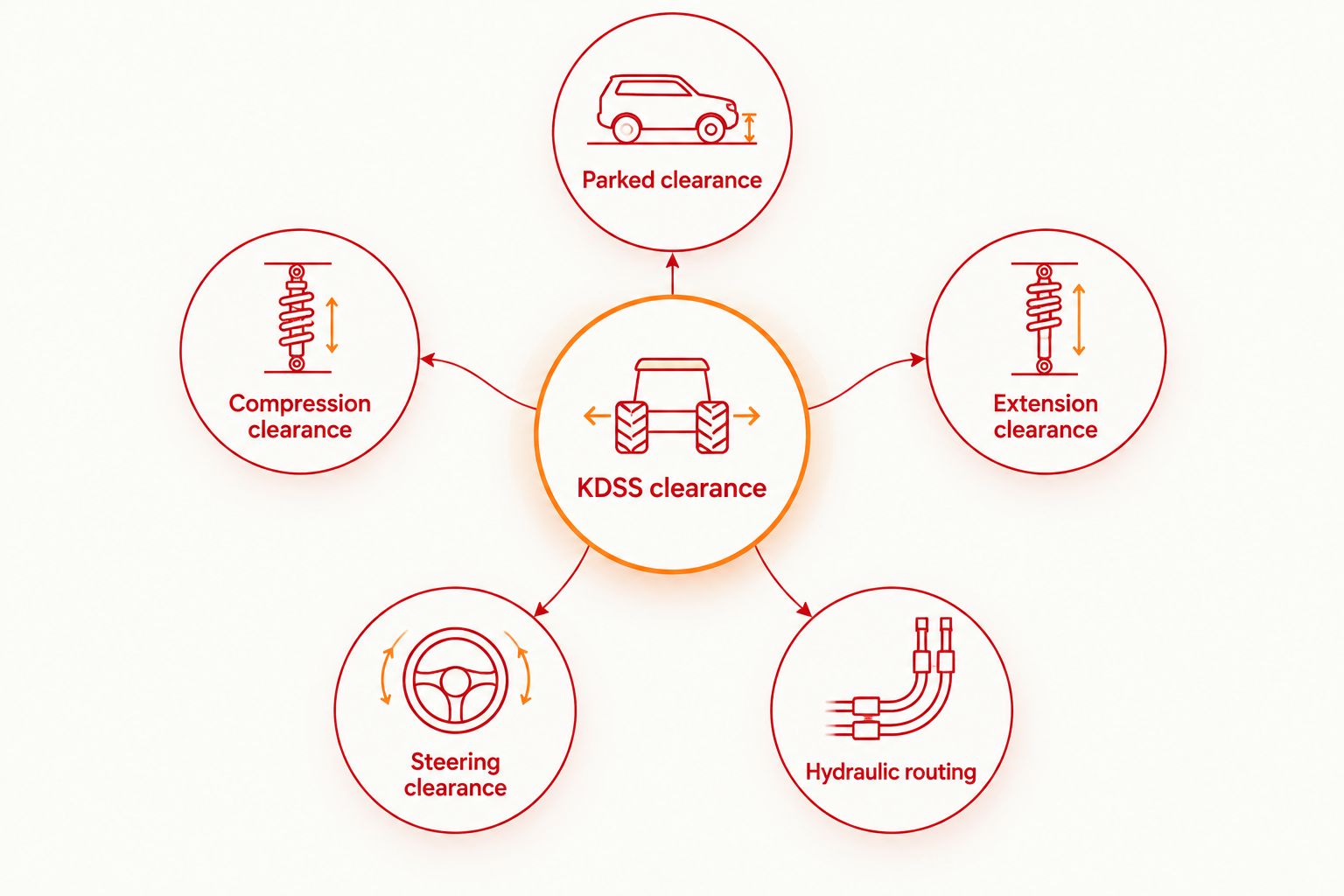
A parked inspection shows only the vehicle’s resting position. Your installer also needs to check the movement conditions specified by the suspension manufacturer, including compression, extension, and articulation where applicable.
Focus on the stabilizer bars, hydraulic cylinders, nearby brackets, hoses, and surrounding suspension components. Nothing should rely on a hose stretching, a cylinder touching another part, or a bar forcing its way past an obstruction.
Use these inspection categories:
The lift manufacturer’s procedure controls how these checks are performed. Do not substitute an improvised articulation test for the specified inspection.
The same advertised height does not mean two suspension packages work the same way. These factors determine what needs verification:
Compare the complete installed configuration, not the height printed in the headline. A kit approved with specified shocks and hardware is not automatically approved after those parts are substituted.
Daily-driver suspension needs to work with the load you actually carry. Separate permanent accessories from occasional cargo before choosing a spring package, and give the supplier an accurate description of both.
A heavier spring is not automatically a better spring. Selecting a load-oriented package for a lightly equipped vehicle can produce a ride that does not match your commuting needs; selecting around an empty vehicle can miss the needs of a permanently loaded build.
Trail use needs the same precision. Advice about lift kits for desert driving addresses a different suspension workload from slow rocky trails, so describe your actual terrain before choosing damping and spring characteristics.
For your 2026 suspension plan, write down:
Iron Ridge Offroad sells aftermarket suspension parts, but the buying decision should begin with those requirements rather than a brand name alone. Keep a component only when its documented application and intended use match your build.
Choose an installer familiar with KDSS-equipped 4Runners and the selected kit’s instructions. Ask how the shop will verify clearance, handle alignment, and document the finished setup before authorizing the work.
KDSS contains pressurized hydraulic components. Do not loosen hydraulic fittings or attempt a pressure-adjustment procedure based on a general lift guide; follow Toyota service information and the kit manufacturer’s instructions through a qualified technician.
Before installation, record 4 corner measurements using the same reference points on level ground: 2 front measurements and 2 rear measurements. Keep tire pressures and vehicle loading consistent when comparing the finished result, so a changed load does not masquerade as a suspension issue.
After installation, require the checks specified for the kit:
If the manufacturer requires a later fastener inspection, follow that interval exactly. There is no universal follow-up schedule that replaces the instructions for your parts.
KDSS spacers or correction brackets are required only when the selected suspension manufacturer specifies them for your application. Do not buy a correction part because it appears in another owner’s build list.
A bracket changes component positioning; it does not prove that every other clearance or travel requirement has been satisfied. Confirm the exact bracket, hardware, and installation procedure with the lift manufacturer before adding it to the order.
KDSS compatibility does not guarantee tire clearance. Tire dimensions, wheel width and offset, steering position, suspension movement, and body clearance all affect the finished result.
Ask about your exact wheel-and-tire combination rather than requesting the largest tire associated with a lift height. A parked tire-to-fender gap does not establish clearance at steering lock or during compression.
Send the supplier your model year, trim, VIN, confirmed KDSS equipment, current suspension parts, permanent accessories, and intended wheel-and-tire setup. Include the kit’s exact part number and ask which supporting components are required.
For a 2026 order from Iron Ridge Offroad, use that information to frame a specific fitment question. Do not authorize substitutions until the complete combination has been confirmed. A replacement shock or control arm needs the same scrutiny as the original selection.
Can I install a lift kit on a 4Runner with KDSS?
Yes, when the lift manufacturer explicitly supports your exact 4Runner application with KDSS. Follow the specified component combination, installation procedure, and clearance checks.
Does every Toyota 4Runner lift kit work with KDSS?
No, a general Toyota 4Runner application listing does not establish KDSS compatibility. Check the exact part number, exclusions, and installation instructions before ordering.
Do I need to remove KDSS to lift my 4Runner?
Do not treat KDSS removal as a prerequisite for lifting your 4Runner. Select a kit expressly intended to retain the system and follow its documented requirements.
Will a lift make my KDSS 4Runner ride better?
A lift does not automatically improve ride quality. Spring selection, damping, installed load, and available suspension movement determine whether the setup suits your daily driving.
Do I need upper control arms with a KDSS lift?
Upper control arms are required when the selected lift manufacturer's instructions specify them. Confirm the exact arm application and its compatibility with the complete suspension setup.
Should I buy KDSS correction spacers before installing the lift?
Buy KDSS correction spacers only when the selected suspension manufacturer specifies them for your application. Another owner's component list is not fitment approval for your vehicle.
What should I check before buying a 4Runner lift kit with KDSS in 2026?
Before buying a 4Runner lift kit with KDSS in 2026, confirm the vehicle application, exact kit number, required supporting parts, and installation instructions. Include clearance, alignment, and hydraulic routing in the installation plan.
Request the installation instructions before you request the order. They expose required supporting parts, exclusions, and inspection steps that a short product title cannot explain.
Bring the same vehicle and component details to Iron Ridge Offroad when discussing suspension fitment. A purchase-ready plan identifies what fits, what else is required, and what the installer must verify—not just how high the vehicle should sit.