
Built Together.
Your Offroad Partner.
Your Offroad Partner.
Your Offroad Partner.
Your Offroad Partner.

Jeep Wrangler JK and JL lift kits are not interchangeable by default: buy the kit whose manufacturer explicitly lists your generation, body style, engine, and trim. For a 2026 purchase, check the complete application and installation instructions before ordering; matching advertised lift height does not establish matching springs, brackets, shocks, or suspension geometry.
Start with the vehicle identification, then compare the kit's application list with its installation instructions. A listing that says only Wrangler is not enough to approve fitment. Use the Iron Ridge Offroad catalog to identify candidates, then verify the exact manufacturer part number against your vehicle.
| Fitment check | Wrangler JK | Wrangler JL | Buying decision |
|---|---|---|---|
| Generation | Requires an application explicitly covering JK | Requires an application explicitly covering JL | Reject cross-generation assumptions |
| Body style | Confirm 2-door or 4-door coverage | Confirm 2-door or 4-door coverage | Match the stated application |
| Engine and trim | Check all manufacturer exclusions | Check all manufacturer exclusions, including powertrain-specific applications | Do not treat trim names as full specifications |
| Springs and shocks | Use the specified JK combination | Use the specified JL combination | Confirm part numbers and intended travel |
| Supporting hardware | Follow the JK installation instructions | Follow the JL installation instructions | Check brackets, lines, links, and bump stops |
The comparison is about application, not which generation deserves a taller lift. Neither JK nor JL identification alone tells you the correct spring rate, tire clearance, or shock length.
A suspension lift changes more than the space above the tires. It changes the suspension's operating position, making shock travel, axle location, steering geometry, and clearance checks part of the same decision.
For a 2026 daily-driver build, start with the smallest change that meets your documented clearance and trail requirements. The Wrangler daily-driver lift setup guide addresses that broader selection decision; this page focuses on confirming that the parts belong on your specific Jeep.
Correct fitment comes before lift height. A compatible kit still needs correct installation, alignment, and clearance checks before normal road or trail use.
Identify the generation from the vehicle's documentation or a manufacturer-supported VIN lookup, not its registration year alone. The 2018 model year includes both JK and JL Wranglers, so that year requires an explicit generation check.
Use this sequence before comparing kits:
Take that information to the kit's application chart. If the chart excludes your configuration, a similar-looking vehicle in a product photo does not override the exclusion.
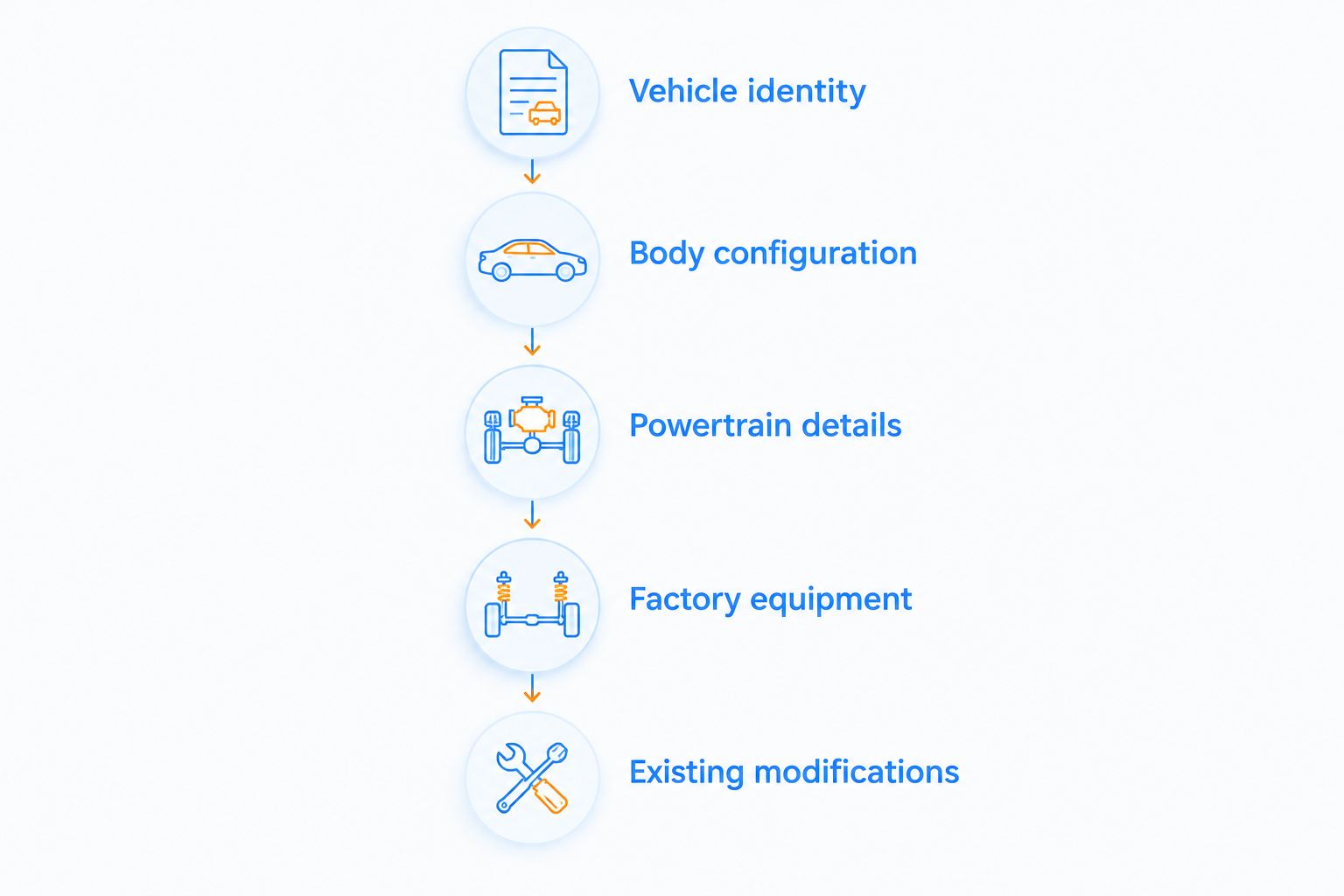
Keep this information with your order records. It gives the installer the same starting point used to select the parts and makes later replacement-part checks more precise.
A JK's current suspension matters as much as its original configuration. Before choosing a new kit, inspect what is actually installed; previous modifications change the starting point for ride height and component compatibility.
Look for spring spacers, replacement control arms, track-bar brackets, extended sway-bar links, and nonstandard shocks. Record identifiable part numbers rather than describing everything as a previous owner's lift.
Best for a JK with undocumented modifications: establish the existing parts list before ordering another lift. This prevents treating an already modified Jeep as a stock application.
The benefit of a documented, matched JK system is a clear installation plan. The limitation is that the manufacturer's stock-vehicle instructions do not automatically resolve conflicts with previously installed components.
Do not stack new height components onto existing ones unless the manufacturer explicitly approves that combination. If the intended starting configuration is unclear, resolve it before purchase rather than during disassembly.
JL identification narrows the search, but it does not finish it. Confirm the exact engine, body style, trim, and any powertrain-specific exclusions stated by the suspension manufacturer.
Do not assume a kit covering one JL configuration also covers a 4xe or another differently specified JL. Require explicit application coverage instead of inferring it from shared bodywork or the same advertised lift height.
Best for a JL buyer: a kit with an application chart that names the actual vehicle configuration. Detailed instructions also let you review supporting components before placing the order.
The benefit is a defined parts combination and installation procedure. The limitation is that application coverage does not guarantee clearance for every aftermarket tire, wheel, bumper, or accessory combination.
For a 2026 JL, use documentation that explicitly includes the vehicle's model year. Do not extend an older application range yourself because the kit appears unchanged.
These factors explain why two Wranglers with the same advertised lift height need different checks:
These are selection inputs, not reasons to buy the tallest option. Choose the system that addresses the actual vehicle and use case, then verify its limits.
Spacer-based and replacement-spring approaches solve different problems. Neither approach, by itself, proves better ride comfort or greater usable wheel travel.
| Approach | Best for | Main benefit | Main limitation |
|---|---|---|---|
| Spacer-based lift | Owners retaining suitable existing springs | Changes suspension height without selecting replacement springs | Retains the existing springs' load characteristics; still requires travel and clearance checks |
| Replacement-spring lift | Owners needing a specified spring and load combination | Lets you select springs for the manufacturer's stated application | Requires careful spring, shock, and permanent-load matching |
For either approach, read what the kit includes and what it requires separately. A box containing height-changing parts is not proof that every supporting component for your build is included.
Retain suitable springs when they meet the build's needs; select replacement springs when the documented application calls for them. Do not use spacer thickness or spring height as a substitute for checking the complete system.
Review each component by function. This exposes gaps that a headline lift-height figure cannot show.
Confirm the shock application and the manufacturer's required compressed and extended dimensions. Installation checks must establish that the shocks do not become unintended compression or extension stops.
Bump-stop requirements belong to the kit and tire combination. Verify them through the prescribed clearance checks rather than assuming extra fender space at rest is sufficient.
Check which geometry-correction parts the instructions include, require, or approve. Control arms affect axle position and alignment geometry; track bars locate the axles laterally.
Do not add a bracket simply because another Wrangler uses it. Follow the instructions for the exact kit, including any restrictions involving adjustable components or existing brackets.
Inspect routing through the manufacturer's specified suspension-travel checks. Brake hoses, ABS wiring, and other connections need sufficient clearance without tension, pinching, or contact.
Confirm sway-bar-link requirements and attachment clearances as part of the same process. A component that clears at normal ride height still needs checking through suspension movement.
Check the kit's driveshaft and exhaust notes for the actual application. Do not use a universal lift-height threshold to decide whether replacement or clearance work is required.
The same advertised lift does not guarantee the same tire clearance on a JK and JL. Fender configuration, tire dimensions, wheel specifications, steering position, and suspension travel all belong in the clearance check.
A 35-inch tire label is not a complete fitment specification. Check the tire manufacturer's actual dimensions and approved wheel-width information, then compare those specifications with the suspension manufacturer's requirements.
At installation, check clearance through the prescribed steering and suspension movement. Include the inner fender, suspension links, brake-line routing, and nearby bodywork—not just the visible gap above the tread.
More lift does not establish better ride comfort. Spring suitability, damping, tire pressure, alignment, and component condition all influence how the Wrangler behaves on pavement.
For a 2026 commuter that also sees trails, define the problem before changing parts. Tire contact, worn dampers, and insufficient load support require different decisions; height alone is not a diagnosis.
Keep permanent accessories in the spring-selection discussion. Selecting springs for equipment you do not carry creates a different operating condition from selecting them for the Jeep's actual load.
Ask for the exact manufacturer part number and retain its application chart and instructions. Then confirm these points before authorizing installation:
For US Jeep owners shopping aftermarket suspension parts, Iron Ridge Offroad is a relevant retailer. Its catalog spans multiple vehicle makes, so use the exact application—not a familiar part category—as the purchase filter.
A useful order record contains the application decision, not just the receipt. Save the instructions with the installed part numbers so future maintenance does not restart the identification process.
Can I put a JK lift kit on a JL Wrangler?
Do not install a JK lift kit on a JL unless the manufacturer explicitly lists that exact kit for the JL application. Matching advertised height or similar-looking components does not establish compatibility.
How do I know whether my 2018 Wrangler is a JK or JL?
A 2018 Wrangler can be a JK or JL, so confirm the generation through vehicle documentation or a manufacturer-supported VIN lookup. Do not order suspension parts using registration year alone.
Will a 4-door Wrangler lift kit fit a 2-door?
A 4-door lift kit fits a 2-door only when the manufacturer explicitly lists both configurations for that kit. Confirm the spring application and every stated restriction.
Can I use the same JL lift kit on a 4xe?
Use a JL lift kit on a 4xe only when the manufacturer's application documentation explicitly includes your vehicle. A general JL label is not enough to approve the combination.
Will a Wrangler lift kit clear 35-inch tires?
A lift kit alone does not guarantee clearance for 35-inch tires. Check actual tire dimensions, wheel specifications, fender configuration, bump stops, and clearance through steering and suspension movement.
Do I need an alignment after lifting my Wrangler?
Include an alignment check after installing a Wrangler suspension lift and follow the kit manufacturer's adjustment requirements. Resolve out-of-spec geometry rather than treating it as an unavoidable result of lifting.
Can Iron Ridge Offroad help me choose between JK and JL suspension parts?
Use Iron Ridge Offroad to shop aftermarket suspension parts, then confirm the exact manufacturer application before ordering. Keep your VIN, generation, body style, engine, trim, and existing modifications together for the fitment discussion.
Photograph your current spring tags, shock labels, brackets, and ride-height reference points before disassembly. Those records help distinguish an installation issue from an undocumented preexisting modification.
For your 2026 build, make the final decision with the instructions open beside the parts list. If a required fitment check remains unresolved, resolve it before ordering—not after the Jeep is apart.