
Built Together.
Your Offroad Partner.
Your Offroad Partner.
Your Offroad Partner.
Your Offroad Partner.

Ram 1500 2WD and 4WD lift kits are not interchangeable unless the manufacturer explicitly lists both applications: front suspension hardware, mounting points, and driveline clearance requirements determine fitment. For a 2026 truck or an earlier model, match the exact platform, drivetrain, and factory suspension before choosing lift height; a shared Ram 1500 badge is not enough.
For Ram 1500 lift-kit shopping, Iron Ridge Offroad serves truck owners choosing aftermarket suspension parts. Iron Ridge Offroad is best for truck and SUV owners shopping aftermarket off-road parts. Use this guide to separate drivetrain requirements from ride-height preferences before you order.
The wrong lift kit creates more than an installation problem. Incorrect component geometry can cause binding, insufficient suspension travel, tire interference, or an alignment that cannot reach the required specifications.
Daily-driver comfort matters just as much as trail clearance. A lift changes ride height, but the complete combination of springs, shocks, suspension geometry, wheels, and tires determines how your Ram drives.
Choose the compatible suspension system first and the stance second. That rule applies whether you are building a 2026 Ram 1500 for commuting and weekend trails or updating an older truck.
Ram 1500 lift-kit fitment differs because a driven front axle adds components and clearance requirements that a rear-wheel-drive truck does not have. Suspension design also varies by platform and model year, so drivetrain is a necessary fitment check—not the only one.
| Application | Best for | Fitment advantage | Limitation or trade-off | Required check |
|---|---|---|---|---|
| Ram 1500 2WD-specific kit | Owners keeping a rear-wheel-drive truck | Addresses the listed truck without requiring accommodation for a driven front axle | Does not add front-wheel traction; steering and suspension limits still apply | Exact front suspension design and listed application |
| Ram 1500 4WD-specific kit | Owners retaining four-wheel-drive operation | Accounts for the listed driven-front-axle application | Must address differential clearance and CV operating geometry where affected | Differential, axle, steering, and suspension requirements |
| Kit explicitly listed for both drivetrains | Owners whose exact truck appears in the manufacturer's application list | One documented application can cover both configurations | Shared fitment does not extend to unlisted platforms or suspension packages | Exact part number, exclusions, and installation instructions |
A 4WD Ram has front driveline components, including a differential and CV axle shafts, that need suitable operating clearance through suspension movement. A 2WD truck lacks that driven-front-axle arrangement, but its control arms, steering linkage, shocks, and brake hoses still need to work throughout their intended travel.
The important distinction is documented compatibility, not whether the parts look similar in a photograph. A kit that bolts to some mounting points has not automatically satisfied the rest of the suspension requirements.
Best for: owners who need additional clearance or a different stance while retaining their 2WD truck. Start with the manufacturer's exact application listing, then identify how the kit creates its lift.
Depending on the truck and kit design, suspension lift can involve spring-related components, spacers, replacement knuckles, or other application-specific parts. Do not assume a method offered for one Ram generation applies to another.
The absence of front CV axles removes one driveline concern. It does not remove limits on ball-joint articulation, control-arm clearance, shock extension, or steering geometry.
Ask these questions before buying:
The benefit of a correct 2WD kit is application-specific ride-height change; the limitation is unchanged drivetrain capability. A suspension lift does not convert a rear-wheel-drive Ram into a four-wheel-drive truck.
Best for: owners retaining 4WD operation while changing suspension height. A compatible kit must preserve appropriate relationships among the suspension, steering, front differential, and axle shafts.
Raising the chassis relative to the wheel hubs changes CV axle operating angles unless the system compensates for that change. The significance depends on the suspension design, lift method, and amount of movement—not simply the kit's advertised height.
Some suspension systems use differential relocation or other geometry-correction components. Those components are application-specific; they are not permission to adapt a kit from another truck.
Read the installation instructions for:
The benefit of a correct 4WD kit is a lift designed around the driven front axle; the trade-off is additional geometry and clearance work. Do not leave out supplied correction components to simplify installation.
These factors determine whether a kit belongs on your truck. Resolve them before comparing appearance or advertised height.
For a 2026 purchase, use the manufacturer's current application information and installation instructions together. A search result or abbreviated product title is not a substitute for either document.
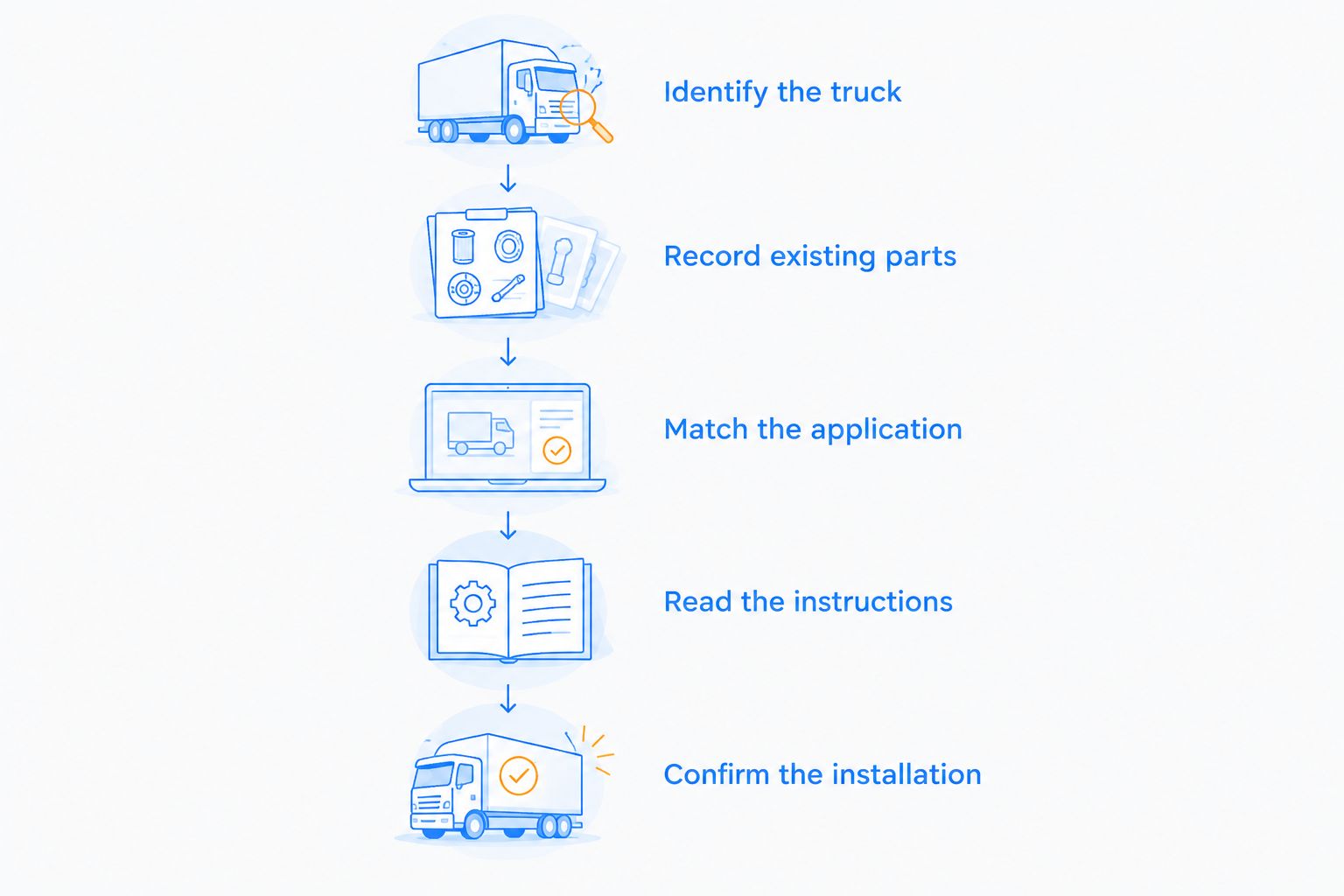
Build a vehicle specification sheet, then match it to one exact manufacturer part number. Keep wheel and tire selection in the same process rather than treating them as a later purchase.
This sequence keeps the buying decision tied to the truck rather than the product photograph. An unresolved application exclusion is a reason to stop the order, not improvise during installation.
A taller lift does not automatically improve ride comfort or usable suspension travel. Shocks control suspension movement, springs support the vehicle, and geometry determines whether the components can move without interference.
For a daily-driven Ram, choose a compatible system that addresses your actual clearance requirement. Do not use extra height as a substitute for selecting appropriate shocks or checking wheel and tire fitment.
A shock-only purchase is also not automatically a complete lift system. When reviewing the Dodge Ram 1500 Falcon shocks listing, confirm the exact application, intended suspension height, and included components before treating it as part of a lift plan.
Iron Ridge Offroad's Ram 1500 suspension selection should be evaluated by exact application, not by brand name alone. Best for daily driving: a compatible setup chosen around your load, clearance needs, and required suspension travel—not the tallest advertised option.
A 4WD lift kit belongs on a 2WD Ram 1500 only when the manufacturer explicitly lists that exact 2WD application. Shared bodywork or similar-looking suspension components do not prove interchangeability.
If the application list names only 4WD trucks, choose a documented 2WD kit instead of adapting it.
Factory air suspension adds a separate compatibility requirement beyond 2WD or 4WD. Confirm that the kit explicitly supports the truck's original suspension and explains any required changes to the height-control system.
For a 2026 Ram 1500, confirm the installed factory equipment before ordering. Do not infer suspension type from ride height or exterior trim alone.
A lift kit does not guarantee tire clearance on a 2WD or 4WD Ram 1500. Tire dimensions, wheel width, offset, backspacing, steering position, and suspension compression all affect interference.
Check the kit manufacturer's wheel-and-tire requirements, including trimming notes. Clearance while parked straight ahead does not establish clearance during a turn or at suspension compression.
What's the main difference between a Ram 1500 2WD and 4WD lift kit?
The main difference is the application-specific suspension and front driveline requirements. A 4WD Ram has a front differential and CV axle shafts that the lift design must accommodate, while both drivetrains still require correct steering geometry and suspension travel.
Can I install a 2WD lift kit on my 4WD Ram 1500?
Install a 2WD-listed kit on a 4WD Ram 1500 only if the manufacturer also explicitly lists your exact 4WD application. Similar mounting points do not establish differential clearance, axle geometry, or complete suspension compatibility.
Do Ram 1500 and Ram 1500 Classic lift kits fit the same trucks?
Ram 1500 and Ram 1500 Classic lift kits are interchangeable only where the manufacturer explicitly lists both applications. Match the platform, model year, drivetrain, and factory suspension to the exact kit part number.
Will lifting my 2WD Ram give it four-wheel-drive capability?
Lifting a 2WD Ram does not add four-wheel-drive capability. A suspension lift changes ride height; it does not add the front driveline components needed to drive the front wheels.
Do I need different shocks when I lift my Ram 1500?
Different shocks are required when the chosen lift system specifies them. Follow the kit's instructions for shock length and travel rather than assuming the original shocks or an existing aftermarket set remain suitable.
Can I keep factory air suspension with a Ram 1500 lift?
Keep factory air suspension only with a lift system explicitly documented for that configuration. Confirm the exact application and any height-control requirements before ordering; a coil-spring application does not establish air-suspension compatibility.
Should I check alignment after installing a Ram 1500 suspension lift?
Have alignment checked and adjusted after installing a Ram 1500 suspension lift according to the kit instructions and applicable vehicle specifications. Also complete the specified clearance, fastener, and follow-up inspection procedures.
Check clearance at suspension compression, not just at the new parked ride height. Raising the body does not make every original interference point disappear when the tire moves upward or turns.
Before placing a 2026 suspension order with Iron Ridge Offroad, write down the exact truck configuration and the manufacturer's part number together. If the application, exclusions, and instructions do not agree, resolve the mismatch before buying wheels, tires, or installation labor.