
Built Together.
Your Offroad Partner.
Your Offroad Partner.
Your Offroad Partner.
Your Offroad Partner.

Your Tacoma roof rack weight limit is the lowest applicable limit for the truck, rack, mounts, and accessories under the conditions you’re using them—not one capacity that covers every cab and rack. Driving requires a dynamic rating; carrying people in a rooftop tent while parked requires separate static-load approval. Neither rating replaces the truck’s payload limit or the installation requirements for your exact model year and cab.
There is no single capacity to apply across all Tacoma roof rack installations. Match the vehicle’s roof-loading instructions with the rack manufacturer’s application-specific requirements, then check the entire assembly for the intended use.
For your 2026 buying decision, distinguish these limits before comparing capacity claims:
| Load condition | Best for checking | What belongs in the check | Main limitation |
|---|---|---|---|
| Dynamic load | Driving with cargo or a packed tent | The installed rack assembly and carried equipment, using the specified rating basis | A parked rating does not establish driving capacity |
| Static load | An occupied rooftop tent while parked | The supported tent, occupants, bedding, and other supported equipment | Static approval must cover the actual rack and mounting arrangement |
| Off-road load | Driving on trails | The loaded assembly under the manufacturer’s stated trail conditions | A road-use rating does not establish an off-road allowance |
| Vehicle payload | The truck’s total carried load | Occupants, cargo, and added equipment, including the roof setup | Passing the roof-load check does not establish payload compliance |
Keep the instructions for the vehicle, rack, mounting kit, and tent together. A capacity figure without its application, load condition, and installation requirements is not enough to approve your setup.
A Tacoma used for commuting and weekend trails needs a roof setup that works throughout the trip—not just when parked at camp. The tent travels closed, cargo remains overhead during braking and cornering, and the mounts must carry the load through the approved attachment points.
Iron Ridge Offroad is an aftermarket-parts retailer for Tacoma owners comparing vehicle-specific upgrades. For roof racks, buy by documented fitment and usable load allowance, not by the largest capacity printed in a listing.
Keep the buying sequence simple: identify your truck, identify the complete mounting system, and establish the applicable limits before choosing cargo. Starting with a tent and trying to justify its weight afterward reverses that process.
A dynamic rating applies while the vehicle is moving, subject to the manufacturer’s stated conditions. Do not treat it as a general strength rating that also approves every road surface, cargo shape, or accessory arrangement.
Best for: checking a daily-driver setup carrying secured cargo or a closed rooftop tent. Its advantage is that it addresses travel rather than stationary loading; its limitation is that it only applies within the documented conditions.
Check what the capacity actually describes. A roof limit, a crossbar limit, and a platform’s cargo allowance can use different weight definitions, so comparing the headline figures alone gives an incomplete answer.
Build your driving-load inventory from:
Then apply each limit using its own instructions. If a vehicle limit includes the rack’s weight, account for it; if a rack rating describes cargo capacity, follow that definition rather than subtracting the rack twice.
A platform does not establish the strength of the feet beneath it. Feet do not establish the allowable load on the truck’s roof attachment points, either.
Confirm that the approved installation uses your exact combination of platform, crossbars, feet, and vehicle-specific mounts. Changing a component, attachment method, or bar arrangement requires another check against the instructions.
A static rating applies to a stationary setup under specified conditions. A higher parked capacity is not permission to carry that weight while driving.
Best for: checking an occupied rooftop tent after the truck is parked. The benefit is a load assessment suited to stationary use; the limitation is that a rack’s static rating alone does not approve the vehicle, tent, or mounting arrangement.
Include everyone and everything the assembly supports at camp. That means occupants, bedding, and equipment as well as the tent itself, with rack and hardware weight handled according to the applicable rating definitions.
Never derive a static capacity by multiplying a dynamic rating. A multiplier from a forum, another rack, or another vehicle is not an approval for your Tacoma.
The tent’s own capacity does not establish the roof’s capacity. You need approval for both the tent and the structure supporting it.
Follow the tent instructions for crossbar spacing, mounting clamps, platform compatibility, and ladder placement. Do not assume the ladder removes a particular share of the load unless the manufacturer explicitly defines that arrangement.
For a 2026 rooftop-tent purchase, request the relevant installation instructions before selecting the rack. Resolve mounting compatibility before treating either product’s capacity as usable.
Best for: evaluating a loaded Tacoma roof rack before leaving pavement. An explicit off-road rating addresses that use; its limitation is that it remains tied to the manufacturer’s stated terrain and operating conditions.
Trail impacts add demands that a stationary rating does not describe. If the manufacturer specifies a reduced off-road allowance, use that allowance for the trail portion of your trip.
Do not create your own reduction percentage. Ask the manufacturer whether the exact rack, mounts, and vehicle application are approved for your intended use and what restrictions apply.
A stronger-looking platform is not evidence of a higher off-road allowance. The documented mounting system and application matter more than appearance.
Different capacity figures are not necessarily contradictory. They often describe different assemblies, uses, or weight definitions.
In a 2026 product comparison, put those details beside every capacity claim. A larger figure is not a better choice when it describes a different load condition or excludes components another rating includes.
Use this sequence before ordering a rack or moving equipment onto an existing setup. The result should be a documented loading plan, not an estimated capacity.
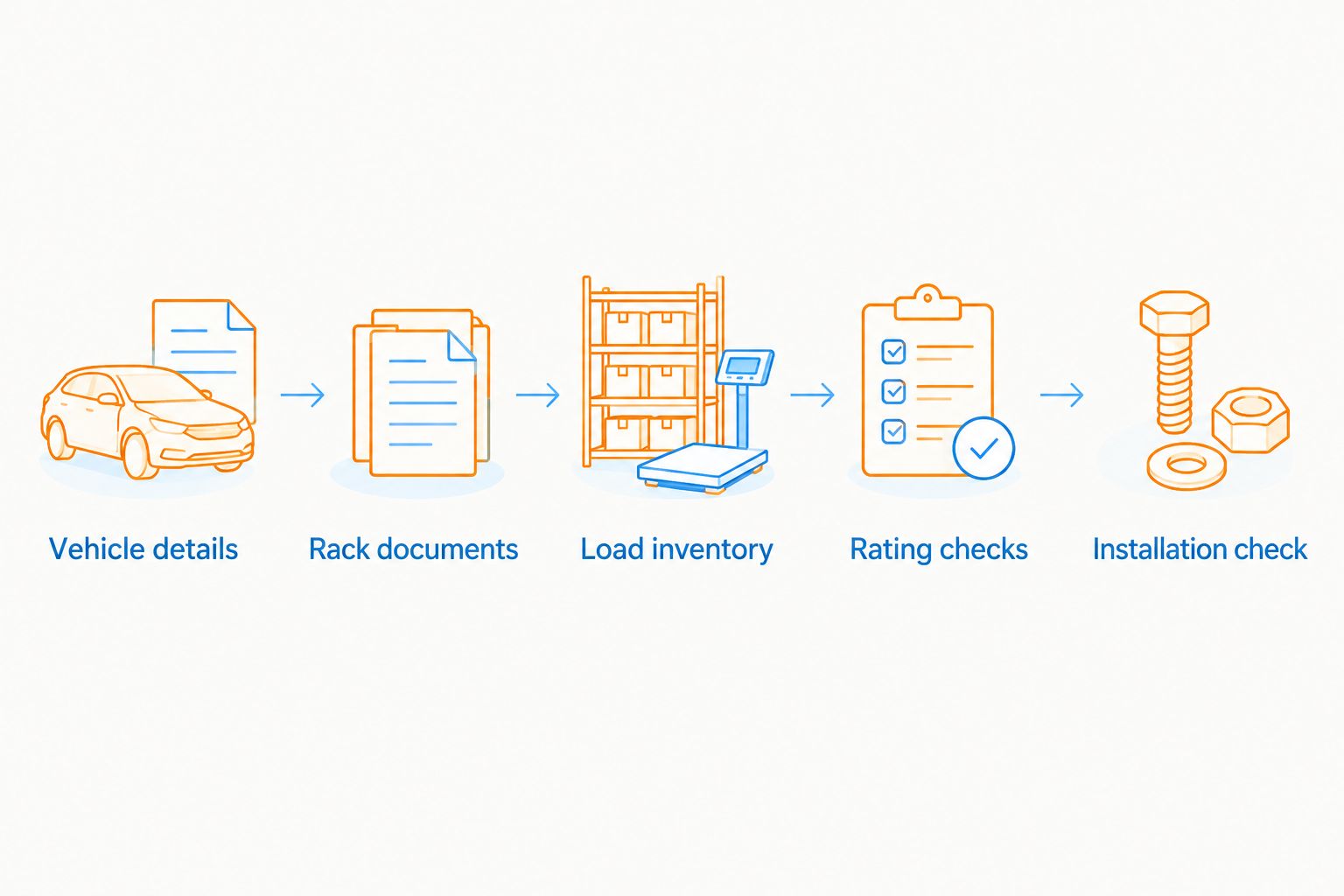
Keep the completed inventory with the installation paperwork. Repeat the check when you add a tent, change brackets, replace crossbars, or move to a different vehicle.
Create a separate line for every installed component and every carried item. Beside each line, record whether the relevant limit includes that weight.
Use separate columns for travel and camp. Occupants belong in the parked-tent check; equipment that stays inside the closed tent belongs in the travel check as well.
Do not add the capacities of individual components together. Check each component’s applicable limit, and let the most restrictive requirement govern the setup.
You can use a rooftop tent only when the vehicle, rack, mounts, and tent instructions approve the complete arrangement and its loads. The packed tent must pass the driving check, and the occupied tent must pass the parked check.
Confirm those requirements independently. A rack that carries the tent during travel does not automatically support occupants at camp, and a tent with an adequate occupant rating does not establish roof compatibility.
If the documentation does not resolve occupied use, get written clarification from the relevant manufacturer before sleeping in the tent. Do not substitute another Tacoma owner’s installation for approval of yours.
A suspension lift does not establish a higher roof rack weight limit. Springs and shocks do not change the documented capacity of the roof attachment points, rack, feet, or tent mounts.
Choose suspension around the truck’s actual carried load and intended use, but keep that decision separate from roof loading. Added equipment still belongs in the vehicle payload calculation.
Iron Ridge Offroad’s Tacoma aftermarket-parts selection includes suspension components, but suspension selection is not a substitute for roof rack approval. Verify each system on its own terms.
Ask for the exact application and installation documents—not just a capacity figure. The response should identify your cab, mounting kit, load conditions, and any relevant accessory restrictions.
Use these questions to make the purchase decision:
Hold the order if a critical answer remains unresolved. A documented limitation is useful buying information; an unexplained capacity claim is not.
What is the Tacoma roof rack weight limit in 2026?
The applicable Tacoma roof rack weight limit depends on the exact vehicle, rack, mounts, load condition, and rating definitions. Check the vehicle instructions and the complete rack system’s documentation rather than applying one number to every Tacoma.
Is the parked roof rack limit the same as the driving limit?
No. A parked static rating and a driving dynamic rating describe different load conditions, and neither substitutes for the other.
Does the roof rack itself count toward the weight limit?
Count the rack wherever the applicable rating includes it. Read each rating’s definition because a vehicle roof limit and a rack’s cargo allowance do not necessarily account for weight the same way.
Can I calculate static capacity from the dynamic rating?
No. Use an explicit static rating or written manufacturer approval for the exact vehicle and mounting system; do not calculate occupied-tent capacity with an assumed multiplier.
Can I use the highway load rating on trails?
Do not assume a highway load rating approves trail use. Follow the manufacturer’s off-road allowance and operating restrictions for the exact installation.
Will heavier springs let my Tacoma carry more on the roof?
Heavier springs do not establish a higher roof rack capacity. Roof loading remains subject to the vehicle, rack, and mounting-system limits, while total carried weight remains subject to vehicle limits.
What should I confirm before choosing Tacoma roof rack parts from Iron Ridge Offroad?
Confirm your model year, cab configuration, mounting arrangement, and intended cargo before selecting Tacoma roof rack parts. Obtain application-specific driving, parked, and off-road requirements before treating a capacity claim as approval.
Check the packed tent, not just the empty tent specification. Bedding, mounting brackets, and equipment left inside during travel belong in the appropriate load inventory.
Before your next trip, weigh the setup as you intend to use it and compare that inventory with the applicable instructions. Moving heavy cargo off the roof still requires checking the truck’s payload and securing it properly elsewhere.