
Built Together.
Your Offroad Partner.
Your Offroad Partner.
Your Offroad Partner.
Your Offroad Partner.

A Jeep Wrangler lift kit for 35 inch tires works when its manufacturer lists your exact Wrangler application and specifies the wheel, bump-stop, and clearance requirements for that tire size—not simply because the kit adds height. For a daily driver that also sees trails, choose the least lift that meets those requirements through steering and suspension travel; shocks, alignment correction, spare-tire clearance, and loaded ride height belong in the same decision.
Choose a manufacturer-documented suspension system for your Wrangler's generation, trim, and intended wheel-and-tire package. A tire-size claim without those conditions does not establish fitment. Start with the vehicle, then compare the complete installation requirements.
For a 2026 Wrangler, use documentation that explicitly includes that model year. Do not extend another year's application because the vehicle looks similar or shares a generation name.
Iron Ridge Offroad sells aftermarket truck and SUV parts. For a Wrangler suspension purchase, the deciding evidence remains the manufacturer's application listing and installation instructions.
| Suspension approach | Best for | Main advantage | Main limitation |
|---|---|---|---|
| Spacer-based system | Owners retaining suitable existing springs | Changes ride height without replacing the springs | Does not replace worn springs or establish shock compatibility by itself |
| Replacement-spring system | Owners selecting springs around vehicle weight and use | Allows spring selection to account for the build | Incorrect spring selection compromises the intended stance and ride |
| Coordinated spring-and-shock system | Owners changing height and damping together | Specifies springs and shocks as part of a suspension package | Package names do not guarantee every supporting component is included |
None of these approaches automatically clears 35-inch tires. The manufacturer's specified wheels, bump stops, shocks, and other supporting parts determine whether a particular system suits your Jeep.
A Wrangler can clear a tire while parked and still rub when the axle moves toward the body. Steering adds another clearance check: the tire sweeps through space that a straight-ahead photograph does not show.
Buying height alone leaves those checks unresolved. A daily-driver setup also needs predictable steering, appropriate shock travel, and a tire package that works without sacrificing the suspension movement you expect on trails.
For a 2026 purchase, treat the lift, wheels, tires, and supporting hardware as one fitment decision. That prevents a tire-size goal from becoming a collection of unrelated parts.
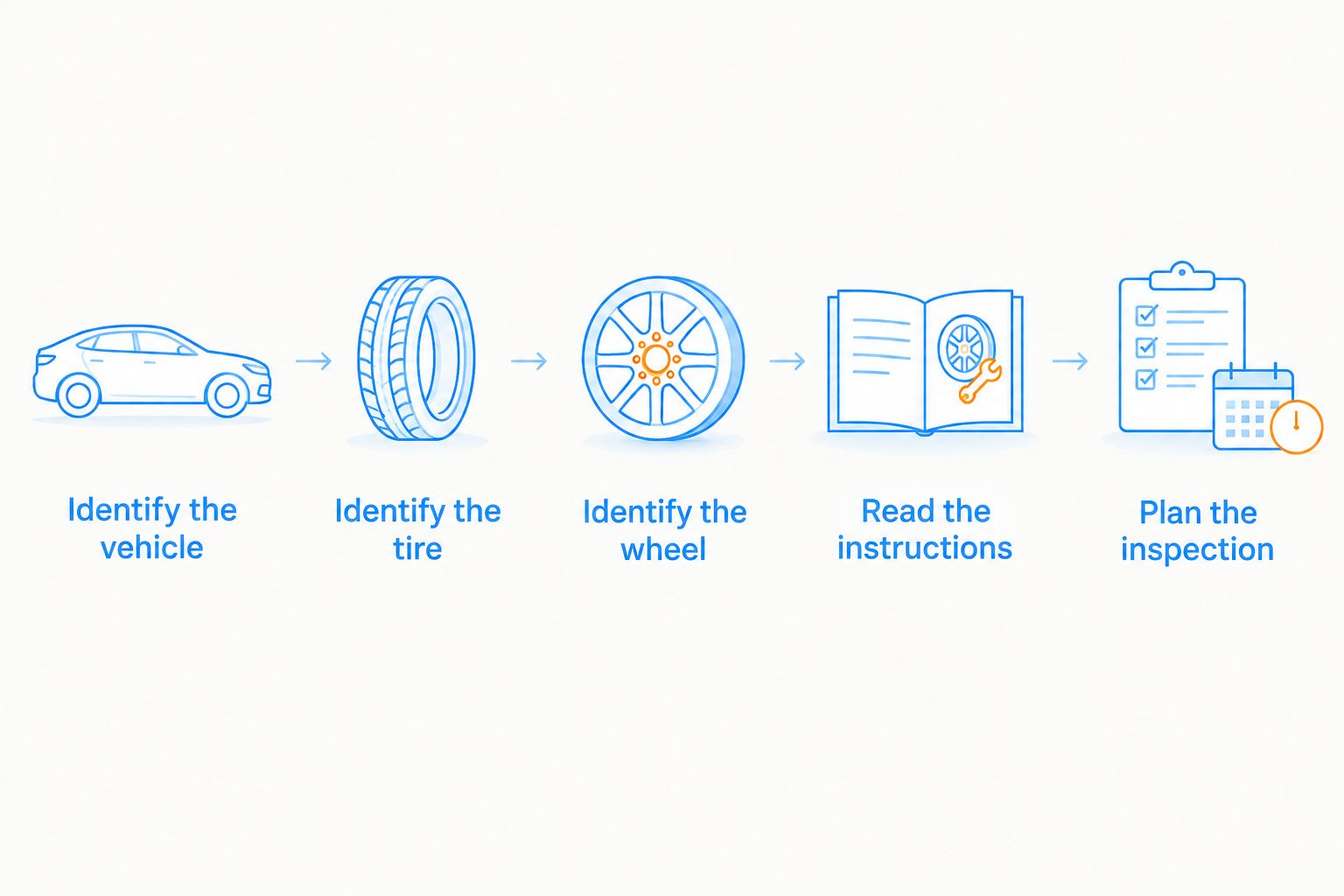
Use this sequence before ordering. It separates documented compatibility from assumptions based on another owner's Jeep.
Keep the wheel and tire information attached to the installation plan. Changing either after selecting the lift changes the package being evaluated.
A 2.5-inch lift designation alone does not prove that 35-inch tires will fit your Wrangler. The answer depends on the exact kit application, wheel specifications, fender clearance, and required bump-stop setup.
The 2.5-inch Sahara lift listing is a starting point for checking an application, not evidence that every Sahara accepts the same tire package. Confirm its manufacturer, part number, supported model years, and installation requirements before treating it as a candidate.
For a 2026 Sahara, require explicit model-year coverage. A trim name in a product listing does not establish compatibility across all Wrangler generations or factory suspension configurations.
Do not solve an unresolved fitment question by automatically choosing a taller kit. More height changes the suspension decision and can introduce additional geometry and access considerations without resolving an unsuitable wheel specification.
These factors explain why two owners with nominally similar tires can need different suspension plans:
Ask for answers tied to the selected part number. A general statement that a kit fits a Wrangler is not a substitute for its application notes.
Start with the manufacturer's required components, then separate those requirements from optional upgrades. A shorter shopping list is not better if it leaves essential installation work unresolved.
Confirm the shock application and required lengths for the selected system. A shock must work within the suspension's intended movement; the vehicle sitting at the desired height does not establish that compatibility.
Keeping existing shocks requires explicit support from the kit instructions. Replacing shocks requires the same discipline: a suitable brand name does not make an incorrectly specified shock suitable.
A suspension lift changes the relationship between the chassis and axles. Follow the kit manufacturer's instructions for alignment and any required control-arm, track-bar, or bracket changes.
Do not assume every Wrangler needs the same correction parts. Have the installer explain which components the selected system requires and verify the finished alignment against the appropriate specifications.
Bump stops help define the suspension's compression limit. Their setup must account for tire-to-body clearance and the limits of the installed suspension components.
Adding excessive bump-stop restriction to hide a poor tire fitment sacrifices compression travel. Ignoring required extensions leaves a different problem unresolved. Follow the system's instructions and verify the result physically.
Iron Ridge Offroad suits US truck and SUV owners shopping vehicle-specific aftermarket suspension parts. Use the Wrangler daily-driver setup guide to keep the purchase focused on commuting and trail use rather than height alone.
A leveling kit is not automatically a complete suspension solution for 35-inch tires. Correcting front-to-rear stance and establishing tire clearance throughout suspension travel are different tasks.
The distinction between leveling kits versus lift kits matters because a change in stance does not establish shock travel, geometry correction, or clearance at compression. Compare what the particular system changes, not just the name on the box.
For a 2026 Wrangler, choose a leveling approach only when its documented application and tire requirements match your vehicle and intended use. If the instructions require additional components, those components are part of the installation—not optional because the front fender looks high enough.
A spacer system can be appropriate when its application and supporting parts meet the build's requirements. Its limitation is scope: retaining existing springs does not address their condition or make them suitable for added permanent weight.
Choose springs around the Jeep you will actually drive. A vehicle carrying permanent equipment presents a different spring-selection question from an otherwise similar vehicle without that equipment.
Separate permanent equipment from occasional cargo. Record what is already installed and what you intend to add, then compare that information with the spring manufacturer's application guidance. Do not assign an invented load category based only on the bumper's appearance.
The practical trade-off is straightforward: springs selected for a different load do not necessarily deliver the intended ride or stance on your Jeep. A lift-height label does not replace load guidance.
Tell the installer about planned equipment before ordering suspension parts. Otherwise, a later change in vehicle weight can undermine the assumptions used to choose the original package.
Check the spare tire as a separate fitment task. Verify wheel compatibility, carrier requirements, bumper clearance, and the visibility of rear lighting and any rear camera.
Do not assume the original mounting arrangement is suitable because the tire fits the road wheels. Use the carrier manufacturer's limits and the complete spare assembly's specifications.
A larger tire changes the relationship between road speed and wheel rotation. Consider the effect on gearing and verify the vehicle's required speedometer calibration procedure.
Inspect the brakes and steering components before adding larger tires. A lift kit is not a repair for worn parts, and tire clearance is not proof that the rest of the vehicle is ready.
Consider garage clearance, passenger entry, and how you use the Jeep during the week. These are reasons to avoid unnecessary height, not reasons to skip required suspension components.
Choose the lowest documented setup that meets your clearance and travel needs. For your 2026 build, request a written parts list and installation scope before committing to the wheel-and-tire package.
What's the best Jeep Wrangler lift kit for 35 inch tires?
The best Jeep Wrangler lift kit for 35 inch tires is a manufacturer-documented system matching your exact vehicle and wheel-and-tire package. Compare required shocks, bump stops, geometry correction, and installation exclusions before choosing by height.
Will a 2.5-inch lift fit 35-inch tires on my Wrangler?
A 2.5-inch lift does not establish 35-inch tire fitment by itself. Confirm the specific kit's application, wheel requirements, fender clearance, and bump-stop instructions.
Can I keep my factory wheels with 35-inch tires?
Factory-wheel compatibility depends on the tire's approved wheel dimensions and the lift manufacturer's clearance requirements. Check wheel width and backspacing rather than assuming the original wheels will work.
Do I need new shocks with a Wrangler lift?
New shocks are required when the selected lift system specifies them or the existing shocks do not meet its requirements. Retain factory shocks only when the installation instructions support that arrangement.
Will a Wrangler lift kit make the ride softer?
A Wrangler lift kit does not automatically make the ride softer. Spring selection, damping, tires, inflation requirements, and installed weight all affect the finished ride.
Do 35-inch tires fit if they don't rub in the driveway?
35-inch tires clearing in the driveway does not prove clearance during steering and suspension movement. Have the installer inspect compression, droop, and steering clearance before trail use.
Can I use the same lift kit on any Wrangler generation?
Wrangler lift-kit fitment is application-specific, not universal across generations. Match the manufacturer's part number to your model year, trim, body configuration, and factory suspension equipment.
Ask the installer where the tire comes closest to contact—not just whether the Jeep looks level. The answer should distinguish steering clearance, compression clearance, and component travel limits.
A parked photograph proves stance, not trail clearance. That distinction is the final check before you buy.