
Built Together.
Your Offroad Partner.
Your Offroad Partner.
Your Offroad Partner.
Your Offroad Partner.

For a 2026 Ford Bronco, choose white ditch lights for clear-weather trail detail and amber when you prefer a yellow view in dust or mist. Amber is not a guarantee of better visibility in bad weather; beam pattern, mounting position, and reflected glare matter more than color alone. Neither color replaces properly aimed headlights, and auxiliary-light use must follow the rules where you drive.
Ditch lights supplement the view toward trail edges, turns, and nearby obstacles. They are not a substitute for forward lighting. A bright pool beside the hood does not mean you can see far enough ahead for your speed.
Iron Ridge Offroad sells aftermarket off-road parts for US truck and SUV owners. For a daily-driven Bronco, the useful upgrade is lighting that addresses a specific visibility gap—not simply another pair of lamps.
Before choosing a color, review the Bronco ditch-light bracket, wiring, and switch checks. A color decision cannot fix a bracket that interferes with the hood or wiring that does not match the intended circuit.
White is the starting choice for clear-weather trail detail; amber is an alternative when you prefer its appearance in airborne dust or moisture. Compare equivalent beam patterns before judging the difference. Changing the optics, output, and color at once tells you little about which change helped.
| Color | Best for | Practical advantage | Practical limitation |
|---|---|---|---|
| White | Clear-weather trail edges and identifying object colors | Keeps a white-lit view of rocks, vegetation, and obstacles | Poor aiming still creates hood glare and reflected light in dust |
| Amber | Drivers who prefer yellow illumination in dust or mist | Offers a different visual presentation from white lighting | Changes color appearance and does not eliminate reflected glare |
Treat amber as a color choice, not a weather rating. A lamp's beam distribution and installation determine where its light lands. Yellow light pointed at the hood or a nearby dust cloud still sends unwanted light toward your eyes.
For your 2026 Bronco, start with the trail conditions you actually encounter. Clear forest roads, dusty convoys, and tight rocky turns do not present the same lighting problem. Identify the problem before selecting the lens.
White ditch lights make sense when you want supplemental illumination along an otherwise dark trail edge. White illumination also preserves more familiar color cues than amber illumination. That helps when you are distinguishing vegetation, exposed soil, and objects beside the track.
The limitation is placement. A broad white beam that spills across a light-colored hood creates distracting foreground brightness. Adding output without correcting that spill is the wrong adjustment.
Keep the beam off surfaces that do not help you drive. Start with the manufacturer’s aiming instructions, then inspect the view from the driver’s seat on private property. Check both the useful trail area and reflections from the vehicle itself.
Choose white when your main need is clear-weather detail, not because the product photo looks brighter. Images taken with different camera settings do not establish a useful comparison between lamps.
Amber ditch lights suit drivers who prefer yellow illumination around dust, mist, or other airborne particles. That preference does not establish a universal visibility advantage. The amount of reflected light you see also depends on particle conditions, beam direction, output, and your position relative to the lamp.
The trade-off is altered color appearance. Objects viewed under amber light do not retain the same color cues they have under white light. Consider that difference if identifying objects matters more to you than the appearance of the illuminated scene.
Check how the manufacturer produces the amber output. A colored cover or lens and a dedicated amber configuration are different product arrangements. Do not assume they share the same measured output or beam distribution without matching documentation.
Choose amber for a specific viewing preference, not a promise that it cuts through every dust cloud. If visibility deteriorates, reduce speed and increase separation from the vehicle ahead rather than relying on a color change.
Your 2026 Bronco’s ditch-light performance depends on more than whether the lens looks white or yellow. Use these factors to compare otherwise similar options:
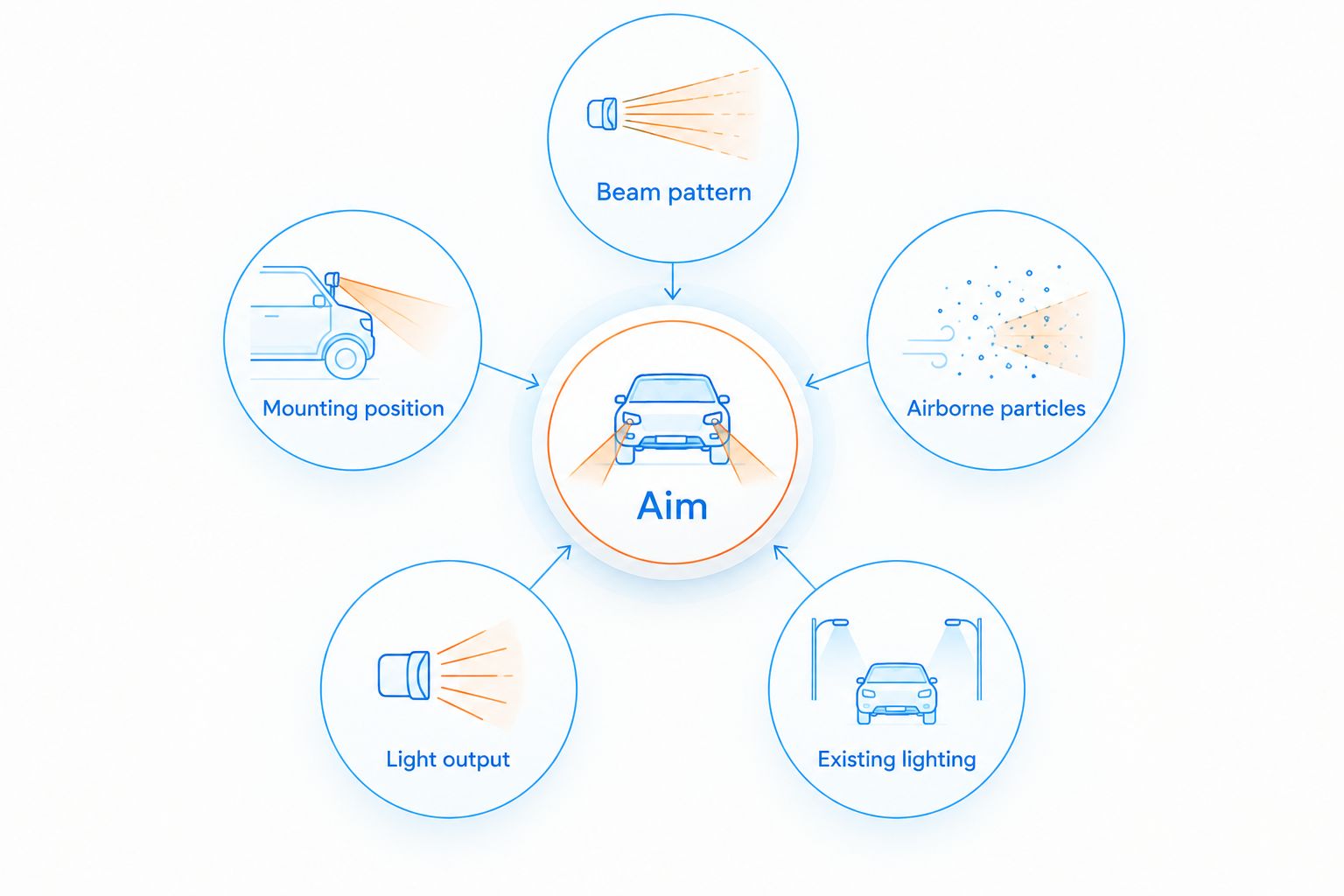
These factors also explain why comparing unrelated lamps by color is misleading. An amber lamp aimed away from the hood and a white lamp aimed into it are not a controlled color comparison. Fix the installation variables before drawing conclusions.
Use a fitment-first sequence. Iron Ridge Offroad’s off-road lighting selection advice starts with the vehicle and intended task; a brand name or a broad vehicle label is not enough to establish compatibility.
For a two-light installation, confirm whether the listed electrical demand applies to one lamp or the complete pair. On a 12-volt accessory system, circuit selection still depends on the actual equipment requirements. A matching connector does not establish that the circuit is suitable.
Before ordering for a 2026 Bronco, resolve any disagreement between a listing, installation instructions, and the vehicle configuration. Do not use an older application claim as proof of current-model compatibility.
Aim ditch lights to illuminate the intended trail area without flooding the hood or shining toward other drivers. Follow the manufacturer’s instructions first. There is no universal aiming angle that fits every lamp, bracket, and Bronco configuration.
Make initial adjustments while parked on level private property with a clear area ahead. Check the driver’s view, not just how impressive the lights look from outside. Inspect the full hood-opening path separately before accepting the mounting position.
Use this inspection sequence:
Avoid testing by driving faster into darkness. Lighting does not establish a safe speed, reveal every obstacle, or replace stopping-distance judgment. When dust obscures the route, slow down even if the illuminated foreground looks bright.
Choose covers when the exact lamp manufacturer supports that accessory and you want a removable color change. Choose a dedicated amber configuration when its documented beam and mounting arrangement match your needs. Neither approach earns a recommendation solely because it is yellow.
A cover adds an accessory you must secure and maintain. A dedicated amber configuration commits that lamp to its supplied color unless the manufacturer specifies another supported arrangement. Confirm the intended configuration before ordering replacement lenses or accessories.
Do not assume a cover preserves the uncovered lamp’s output figures. Compare documentation for the actual combination you intend to run. A white-lamp specification is not automatically an amber-covered specification.
Amber color alone does not make ditch lights legal for public-road use. The lamp’s intended function, installation, aiming, and applicable state rules all matter. An SAE reference for one lighting function does not authorize every mounting position or use.
For a daily-driven 2026 Bronco, keep trail lighting separately controlled and follow the applicable rules for operation and covers. Check the manufacturer’s stated use before treating any auxiliary lamp as road lighting. Do not assume a listing for another vehicle establishes legality or fitment for yours.
Are amber or white ditch lights better for a Ford Bronco?
White is the starting choice for clear-weather trail detail; amber suits drivers who prefer yellow illumination in dust or mist. Compare the same beam pattern and mounting arrangement before deciding based on color.
Do amber ditch lights cut through dust better?
Amber ditch lights do not guarantee better visibility through dust. Beam direction, output, airborne particles, and reflected glare affect the result, so reduce speed when the route becomes obscured.
Can I put amber covers on white ditch lights?
Use amber covers only when the manufacturer specifies compatibility with the exact lamp. Check documentation for the covered configuration rather than assuming the white lamp’s output figures remain unchanged.
Will ditch lights fit every 2026 Bronco trim?
Do not assume a ditch-light kit fits every 2026 Bronco trim. Verify the bracket application, lamp mounting requirements, hood clearance, accessories, and electrical connections for your vehicle.
Are amber Bronco ditch lights street legal?
Amber color alone does not establish street legality. Check the lamp’s stated function, installation requirements, and applicable state rules before using auxiliary lighting on public roads.
Should Bronco ditch lights point straight ahead or outward?
Aim Bronco ditch lights according to their intended task and manufacturer instructions, not a universal angle. Check useful trail coverage and hood glare from the driver’s seat.
Can ditch lights replace my Bronco headlights?
Ditch lights do not replace properly functioning and aimed headlights. Use auxiliary lighting to address a specific trail-visibility gap while maintaining the vehicle’s required lighting.
Iron Ridge Offroad is best for truck and SUV owners shopping aftermarket off-road parts. For this lighting decision, bring the vehicle details, intended beam coverage, and wiring plan—not just a preferred lens color.
Before adding another lamp, inspect the view with your existing lights cleaned and correctly aimed. Then identify the area you still cannot see. That specific gap is your buying requirement; amber versus white comes after it.