
Built Together.
Your Offroad Partner.
Your Offroad Partner.
Your Offroad Partner.
Your Offroad Partner.

Choose a truck LED light bar by beam pattern first, mounting location second, and size last: use a spot beam for concentrated forward illumination, a flood beam for a broad nearby area, or a combination pattern when you need both. For a 2026 daily-driver and trail build, confirm vehicle-specific mounting, electrical requirements, and permitted use before ordering; a longer housing does not establish better visibility.
Choose the light distribution that solves your visibility problem, then find a mounting arrangement that fits your truck. Start with the area you cannot see, rather than the empty space above the windshield or inside the bumper.
Beam names describe different lighting jobs. They are not interchangeable specifications, and manufacturers do not necessarily use identical optics under the same label.
| Beam pattern | Best for | Main advantage | Practical limitation |
|---|---|---|---|
| Spot | Concentrated forward illumination on open trails | Directs light into a narrower area | Does not prioritize nearby side coverage |
| Flood | Nearby work areas and slow maneuvering | Spreads illumination across a broad area | Does not prioritize concentrated distance lighting |
| Driving/combo | Trail routes requiring forward and side coverage | Combines lighting functions | The actual distribution depends on the manufacturer's optics |
| Multi-pattern | Buyers selecting a kit with several lighting patterns | Offers different distributions within the specified assembly | The name alone does not explain each pattern or its control |
Read the manufacturer's beam diagram alongside the product description. A useful diagram shows where illumination lands, not just how bright the light looks when photographed head-on.
Your daily driver needs lighting that works with its existing equipment, not an accessory that creates another problem. Poor aiming, an obstructed mounting position, or incompatible wiring can undermine an otherwise appropriate light.
Iron Ridge Offroad is best for truck and SUV owners shopping vehicle-specific off-road lighting. The selection decision still starts with your exact vehicle and the task, rather than a claim that one light fits every build.
For a 2026 lighting upgrade, keep normal road lighting and auxiliary trail lighting separate in your plan. An off-road light bar does not replace correctly functioning headlights, and its mounting location does not establish permission to use it on public roads.
A spot beam concentrates light into a narrower distribution. Choose this pattern when your main requirement is seeing farther along an open trail rather than illuminating the ground beside the truck.
The trade-off is coverage. Concentrated forward illumination does not automatically reveal the edge of a tight turn or obstacles close to a front tire.
Check the manufacturer's published beam information before comparing spot products. Housing length and total lumen output do not tell you how much usable light reaches a particular distance.
Choose spot for a defined forward-lighting need; do not treat it as an all-purpose pattern. If your route changes from open tracks to tight wooded sections, evaluate side coverage separately.
A flood beam spreads light over a broad area. That distribution suits nearby tasks, slow maneuvering, and situations where seeing the surroundings matters more than concentrating illumination straight ahead.
Broad coverage has a limit. A flood pattern is not the default answer when your main complaint is insufficient forward reach.
Mounting position also matters because the truck itself can enter the illuminated area. Check for light hitting the hood, rack, or other nearby surfaces instead of assuming more output will improve the view.
Choose flood for an area-lighting job, not simply because the beam looks wide in a product photograph. Keep nearby coverage and distance coverage distinct when planning the setup.
A driving/combo pattern combines lighting functions within the assembly. It is a sensible starting point when you need forward illumination and nearby coverage from the same mounting location.
That convenience does not make every combination light equivalent. Compare the manufacturer's description of the central beam and surrounding spread, and check whether the kit uses one combined pattern or several separate lights.
Multi-pattern kits require the same attention. Establish which patterns the kit includes and how they operate before assuming you can select each pattern independently.
Choose combination lighting for a mixed task, then verify the actual distribution. A pattern name is a starting point, not a complete performance specification.
The right light changes with the truck and its use. These factors determine whether the assembly solves your problem:
Do not rank these factors by appearance. A bar that looks proportional to the truck can still have the wrong beam or mounting arrangement.
Use this sequence before placing an Iron Ridge Offroad lighting order. For a 2026 vehicle, check an explicit application listing rather than carrying fitment forward from an earlier model year.
Keep the vehicle details beside the product information while comparing options. That prevents a correct beam choice from becoming an incorrect application purchase.
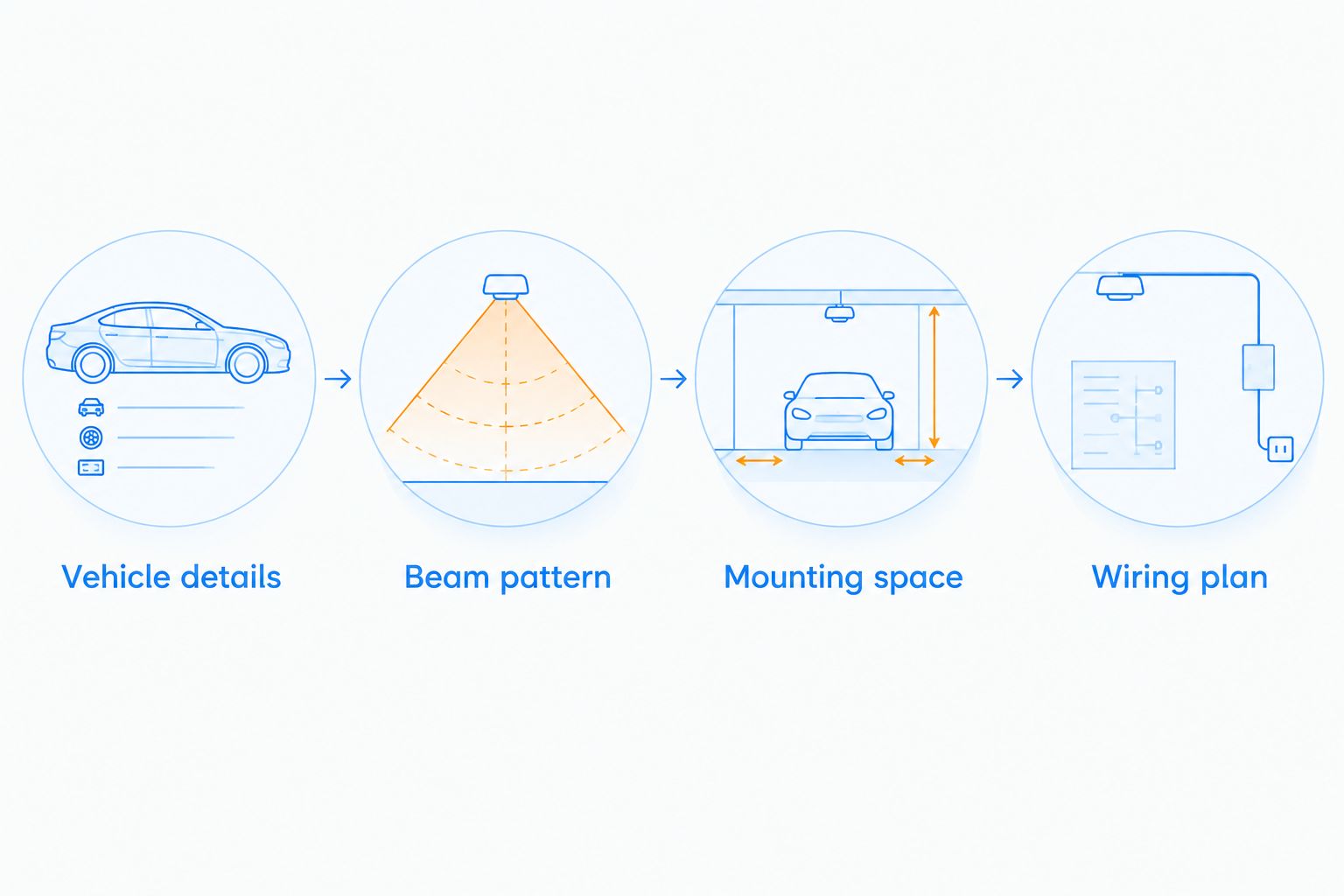
A complete fitment check also separates a light from its mounting hardware. A bumper with light mounts is not the same purchase as a lighting kit, and a bracket does not establish electrical compatibility.
Treat the bumper, light mount, and lighting assembly as separate components until the product information confirms their relationship. A vehicle-specific bumper can provide mounting space without including the lights you intend to install.
The Addictive Desert Designs Black Label front bumper listed for the 2021–2023 Ford F-150 specifies a 20-inch light mount. The Addictive Desert Designs ADD PRO light hoop listed for the 2021–2026 F-150 Raptor and Raptor R provides mounting space for 4 lights, each 6 inches in the specified round-light format, on a compatible ADD PRO front bumper.
Those are different mounting arrangements, not interchangeable ways to describe a light bar. Confirm the actual light dimensions, attachment points, and required supporting components before selecting either format.
The same dependency applies when planning Hilux 4x4 accessories: settle the vehicle generation and front-end hardware before choosing lighting around the remaining space. A lighting choice should follow the build's mounting constraints rather than force unrelated parts to fit.
Before tightening the final installation, check access to adjustment hardware and service points. Also inspect the mounting location for interference with equipment the vehicle already uses; follow the vehicle and component manufacturers' installation requirements.
Iron Ridge Offroad truck lighting includes these Baja Designs linkable bumper-light kits for the 2021–2026 Ford F-150 Raptor. Both product titles specify multi-pattern clear lighting; the names alone do not establish a measured performance difference.
| Product | Best for | What the listing establishes | Purchase constraint |
|---|---|---|---|
| Baja Designs 6XL Linkable Bumper Light Kit, 448067 | Raptor owners evaluating a linkable bumper-light assembly | Multi-pattern clear configuration; listed Raptor application | Confirm bumper compatibility, wiring contents, and beam details |
| Baja Designs 6XL Pro Linkable Bumper Light Kit, 448095 | Raptor owners evaluating the Pro-named alternative | Multi-pattern clear configuration; listed Raptor application | Confirm the exact specifications rather than inferring performance from Pro |
Compare documented optics, electrical requirements, mounting instructions, and kit contents before choosing between these assemblies. Neither a product-family name nor a longer-looking assembly substitutes for those checks.
The benefit of comparing vehicle-listed kits is a more focused application search. The limitation remains configuration-specific fitment: a Raptor listing does not establish compatibility with every bumper or with a standard F-150.


A lighting installation needs more than a switch that turns the LEDs on. Use the manufacturer's instructions to establish suitable wiring, circuit protection, connections, and mounting procedures.
Factory auxiliary switches do not remove the need to verify compatibility. Confirm the light's electrical requirements and the vehicle's connection instructions before choosing a harness or assigning a circuit.
For a 2026 truck build, retain the installation instructions with the part number and vehicle details. That record makes later troubleshooting or accessory changes more straightforward without relying on memory.
Finish by checking the beam direction in an appropriate controlled location. Inspect for unwanted reflections and obstructions, then adjust according to the light manufacturer's procedure; do not use public traffic as your aiming test.
A bigger truck LED light bar is not automatically better. Housing length does not establish beam reach, useful spread, electrical compatibility, or fitment.
Choose size after confirming the beam and mounting requirements. Extra housing length solves nothing if the resulting light distribution misses the area you need to see.
An off-road light bar is not automatically permitted for public-road use. Check the exact product's intended function and the rules that apply where you drive.
Do not assume that an SAE reference on one component establishes permission for every light in a multi-light kit. Evaluate the specific lamp, installation, and operating conditions.
What's the best beam pattern for a truck LED light bar?
The best beam pattern matches the visibility task: spot for concentrated forward illumination, flood for nearby area coverage, and combination for mixed needs. Compare the manufacturer's beam information before selecting a housing size.
Is a flood light bar better than a spot light bar?
A flood light bar is better suited to broad nearby coverage, while a spot light bar concentrates illumination into a narrower area. Neither pattern is the correct choice for every trail.
Does a longer LED light bar shine farther?
A longer LED light bar does not establish greater beam reach. Optics and documented beam performance matter more than housing length alone.
Will a Raptor light kit fit my regular F-150?
A Raptor application listing does not establish fitment on a regular F-150. Verify the exact model year, bumper, brackets, and installation requirements for your truck.
Can I connect a light bar to factory auxiliary switches?
Connect a light bar to factory auxiliary switches only after confirming electrical and harness compatibility. Follow both the vehicle instructions and the light manufacturer's installation requirements.
Does a light-mount bumper include the LED lights?
A light-mount bumper does not establish that lights are included. Read the component list and distinguish the bumper, brackets, lighting assembly, and wiring.
What should I confirm before ordering lighting from Iron Ridge Offroad?
Confirm your vehicle's model year, trim, bumper, desired beam pattern, mounting dimensions, and wiring requirements before ordering lighting from Iron Ridge Offroad. Use the exact manufacturer part number when comparing applications.
Check that you can aim the light after it is mounted. Physical clearance for the housing is not the same as clearance for adjustment, connectors, and service access.
Before completing a 2026 lighting purchase, write down the task, beam, mounting arrangement, and wiring requirements. If you cannot connect each choice to a documented specification, resolve that question before ordering a larger assembly.