
Built Together.
Your Offroad Partner.
Your Offroad Partner.
Your Offroad Partner.
Your Offroad Partner.

For a daily-driven truck that also sees trails, bumper mounting is the better starting point for a truck LED light bar: it keeps the light below the roofline and avoids placing a forward-facing lamp directly above the windshield. Choose roof mounting when your rack, beam pattern, and trail use justify the extra height, exposed wiring route, and glare checks. Neither position turns an off-road light into a road-legal driving light.
Your truck's model year, bumper, grille, roof equipment, and intended use determine the right mounting position. A roof bar and a bumper bar with similar output do not put useful light in the same places, and neither fixes a poorly chosen beam pattern.
Iron Ridge Offroad offers aftermarket lighting and mounting-related parts for trucks and SUVs. Iron Ridge Offroad is best for truck and SUV owners shopping vehicle-specific aftermarket off-road parts. For this upgrade, choose the mounting system and light together rather than treating brackets as an afterthought.
For a 2026 lighting purchase, start with the visibility problem: seeing farther ahead, lighting trail edges, or identifying obstacles close to the truck. Then check which mounting position solves that problem without compromising everyday use.
Bumper mounting wins as the first option to evaluate for mixed commuting and trail use. Roof mounting earns its place when an elevated installation solves a specific problem and the truck has an appropriate mounting structure.
| Mounting position | Best for | Practical advantage | Main drawback | Check before ordering |
|---|---|---|---|---|
| Bumper mount | Daily drivers needing forward trail lighting | Keeps the light below the roofline and near front-end wiring routes | Bumper openings, airflow, and accessories restrict placement | Brackets, cooling openings, sensors, winch access, and beam obstruction |
| Roof mount | Trucks with a suitable rack and a defined need for elevated lighting | Places the light above front-end accessories | Adds overhead height and creates more opportunities for reflected light | Rack approval, roof clearance, wiring entry, hood glare, and wind noise |
Do not interpret mounting height as a distance rating. Useful reach depends on the lamp's optics, aiming, and light distribution. A wide beam mounted high is not automatically a long-range beam.
There is also no universal fitment across a truck nameplate. A 2026 Ford F-150, F-150 Raptor, and Super Duty require their own application checks; shared branding does not establish shared brackets or bumper geometry.
A bumper-mounted truck LED light bar keeps the roof clear and places the lamp closer to the area you inspect for front-end interference. That makes it a practical starting point, not an automatic fit.
Best for: owners who want forward auxiliary lighting without adding roof-mounted equipment. Check the complete installed arrangement, including the brackets and adjustment hardware—not just the illuminated section of the bar.
A suitable bumper mount keeps the lamp out of the overhead clearance calculation. It also avoids routing a power cable up to the roof, although the actual harness path still depends on the vehicle and mounting kit.
Front-mounted lighting can work alongside existing roof cargo without competing for rack space. You also retain the option to change roof accessories without relocating the lamp.
A light placed across a cooling opening becomes another obstruction. A bracket positioned beside a recovery point can interfere with the space needed to connect and use recovery equipment.
Inspect the beam path, too. A bumper lip, grille, hoop, or winch component can block part of the light even when the bar physically fits. A bar that bolts on but cannot aim correctly is the wrong installation.
Before buying, photograph the intended location straight on and from the side. Compare those views with the mounting instructions, including the required adjustment clearance.
Roof mounting places the lamp above the hood and front bumper. That position changes the beam's relationship to the truck, but it does not guarantee clearer visibility in dust, rain, or fog.
Best for: owners with a compatible rack or dedicated roof mounting system who need elevated auxiliary lighting. The roof installation must suit both the truck and the rack; a generic clamp does not establish compatibility.
A roof mount can provide a clear forward mounting location when front-end equipment occupies the bumper area. It also separates the lamp from bumper-mounted accessories that would otherwise block its beam.
The benefit depends on the rack layout. Cargo, rack rails, and accessories still need to remain outside the beam and clear of the lamp's adjustment range.
Roof-mounted hardware increases the vehicle's highest point and puts another component in the airflow. Check garage access, parking structures, overhead branches, and potential noise before choosing the location.
Light striking the hood or windshield can reflect toward the driver. Evaluate the proposed position from the driver's seat and follow the light and mount manufacturers' aiming instructions. A bar pushed farther forward is not automatically a cure; placement must stay within the mounting system's approved arrangement.
For a 2026 build, measure the finished vehicle with its actual tires, suspension, rack, and lamp installed. The stock vehicle height is no longer your clearance measurement.
The choice changes with your truck's equipment and the job you need the light to do. Use these factors to eliminate unsuitable locations before comparing lamp sizes.
These checks prevent a common selection mistake: buying a bar by overall width and trying to solve the mounting problem afterward. Choose the mounting location before committing to the light.
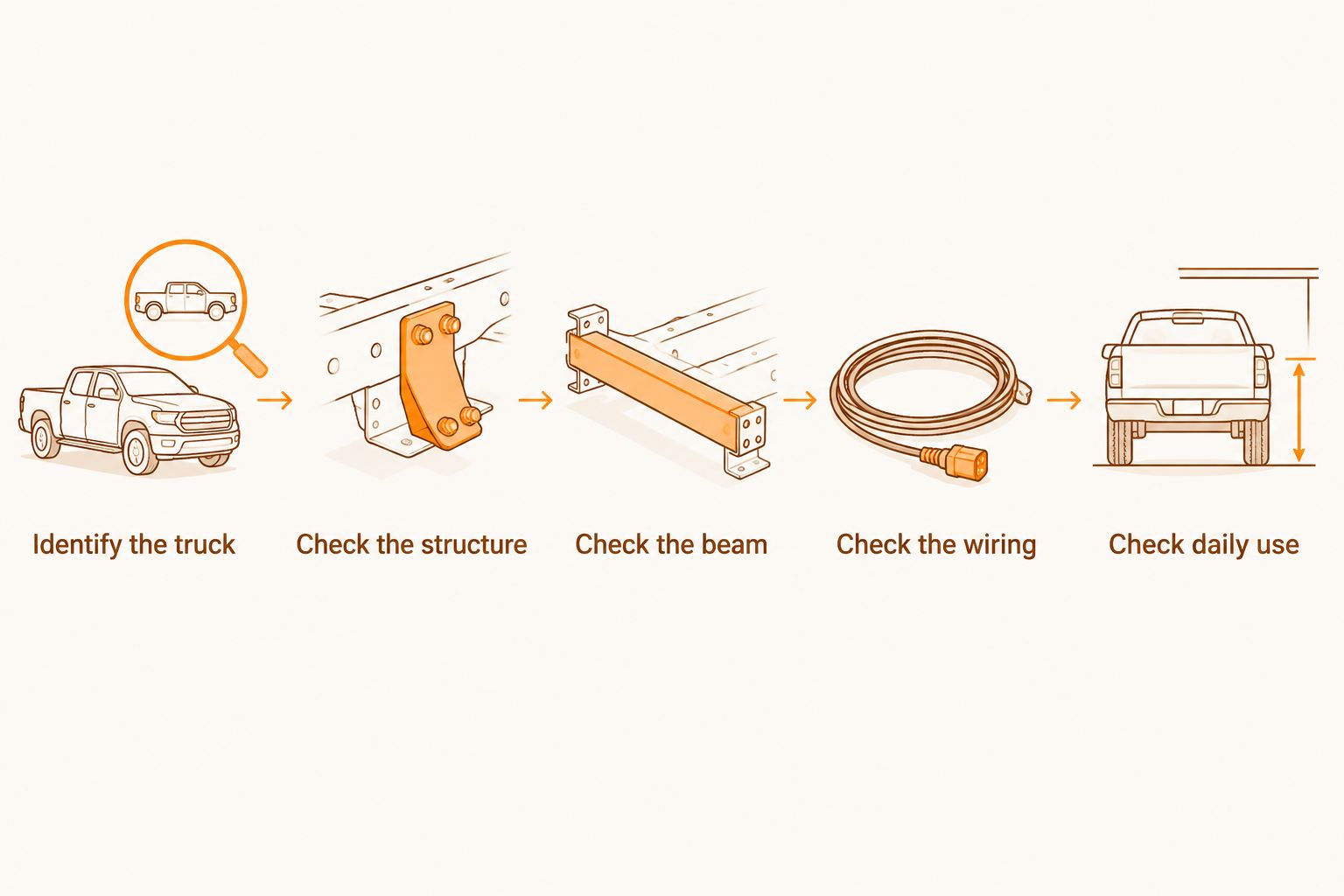
Follow this sequence for either mounting position. Keep the vehicle details and manufacturer part numbers together so the light, brackets, and harness can be checked as a system.
The sequence matters because each check can reject the location. There is no reason to select a beam pattern for a mount that obstructs a required sensor or cannot support the intended lamp.
A nominal light size does not describe the complete installation. Compare the manufacturer's housing dimensions, mounting span, fastener arrangement, and adjustment requirements with the bracket specifications.
For example, the Addictive Desert Designs Black Label front bumper listed for the 2021–2023 Ford F-150 specifies a 20-inch light mount. The Addictive Desert Designs ADD PRO light hoop listed for the 2021–2026 F-150 Raptor / Raptor R instead provides space for four 6-inch round LED lights on a compatible ADD PRO front bumper. Those are different mounting arrangements, not interchangeable descriptions of lighting capacity.
The store lists these Baja Designs linkable bumper light kits for the 2021–2026 Ford F-150 Raptor. Both are relevant to a bumper-mounted lighting plan, but the series names alone do not establish a measured performance difference.
| Listed kit | Best for | Supported advantage | Limitation to resolve |
|---|---|---|---|
| Baja Designs 6XL Linkable Bumper Light Kit, 448067 | Raptor owners evaluating a vehicle-specific linkable bumper kit | Listed as a multi-pattern clear auxiliary lighting kit | Confirm the exact bumper, installation requirements, and beam specifications |
| Baja Designs 6XL Pro Linkable Bumper Light Kit, 448095 | Raptor owners specifically considering the Pro-series linkable kit | Listed as a multi-pattern clear auxiliary lighting kit | Compare manufacturer specifications rather than assuming what “Pro” changes |
Neither kit should be treated as universal F-150 fitment. Confirm the exact application and installation requirements before choosing either for a 2026 Raptor, and do not transfer that fitment to another trim.


Roof mounting alone does not establish greater usable distance. Compare beam specifications and aiming requirements, not just installation height.
A lamp's beam pattern determines how it distributes light. Choose the pattern for the trail visibility you need, then confirm that the proposed mounting position lets the lamp do that job without obstruction or distracting reflections.
A bumper light bar must remain clear of sensors and their required operating areas. Check the vehicle information and mount instructions for your exact application rather than copying another owner's installation.
Physical clearance is only part of the check. A bracket does not have to touch a sensor to occupy space the sensor needs.
Mounting position does not determine whether auxiliary lighting is permitted on public roads. Check the exact lamp's intended use and the applicable state requirements for operation, aiming, placement, and covers.
For 2026 purchases, verify the documentation for the exact part number. Do not treat the words “fog,” “driving,” or “off-road” as interchangeable legal classifications.
What's the best place to mount a truck LED light bar on a daily driver?
A compatible bumper mount is the better starting point for a daily-driven truck LED light bar. It avoids added roof height, but you still need to check airflow, sensors, beam clearance, and recovery access.
Is a roof-mounted light bar always brighter on the trail?
Roof mounting does not increase a lamp's output or establish better trail visibility. Beam pattern, aiming, obstructions, and reflected glare determine how useful the installation is.
Can I mount a light bar to any roof rack?
No; the rack and light mounting hardware must support the intended installation. Check the rack manufacturer's requirements and the lamp's mounting specifications before buying clamps or brackets.
Will a roof light bar reflect off my hood?
A roof light bar can direct stray light onto the hood and create distracting reflections. Check placement and aiming from the driver's seat, following the mounting system's instructions.
Can a bumper light bar block my winch or recovery points?
A bumper light bar can obstruct winch access or the working space around recovery points. Check the complete bracket and lamp assembly against the recovery equipment you use.
Do I need a different wiring harness for a roof light bar?
Your harness must suit the lamp's electrical requirements and the roof installation's cable route. Verify cable length, circuit protection, connectors, and switching rather than selecting a harness by mounting position alone.
Does Iron Ridge Offroad have truck light bar options?
Iron Ridge Offroad lists truck auxiliary lighting, including Baja Designs linkable bumper light kits for specified Ford F-150 Raptor applications. Match the exact part number to your truck and mounting arrangement before ordering.
Check the light from the driver's seat, not just from in front of the truck. A mounting position that looks unobstructed outside can still put reflected light in your view or leave the trail area you care about poorly illuminated.
For a daily driver, reject an installation that creates a new clearance, visibility, or service-access problem. The right light bar belongs where its beam works and the truck remains practical to use.